Custom Commercial Millwork: Make Spaces Work Better (2026 Guide)
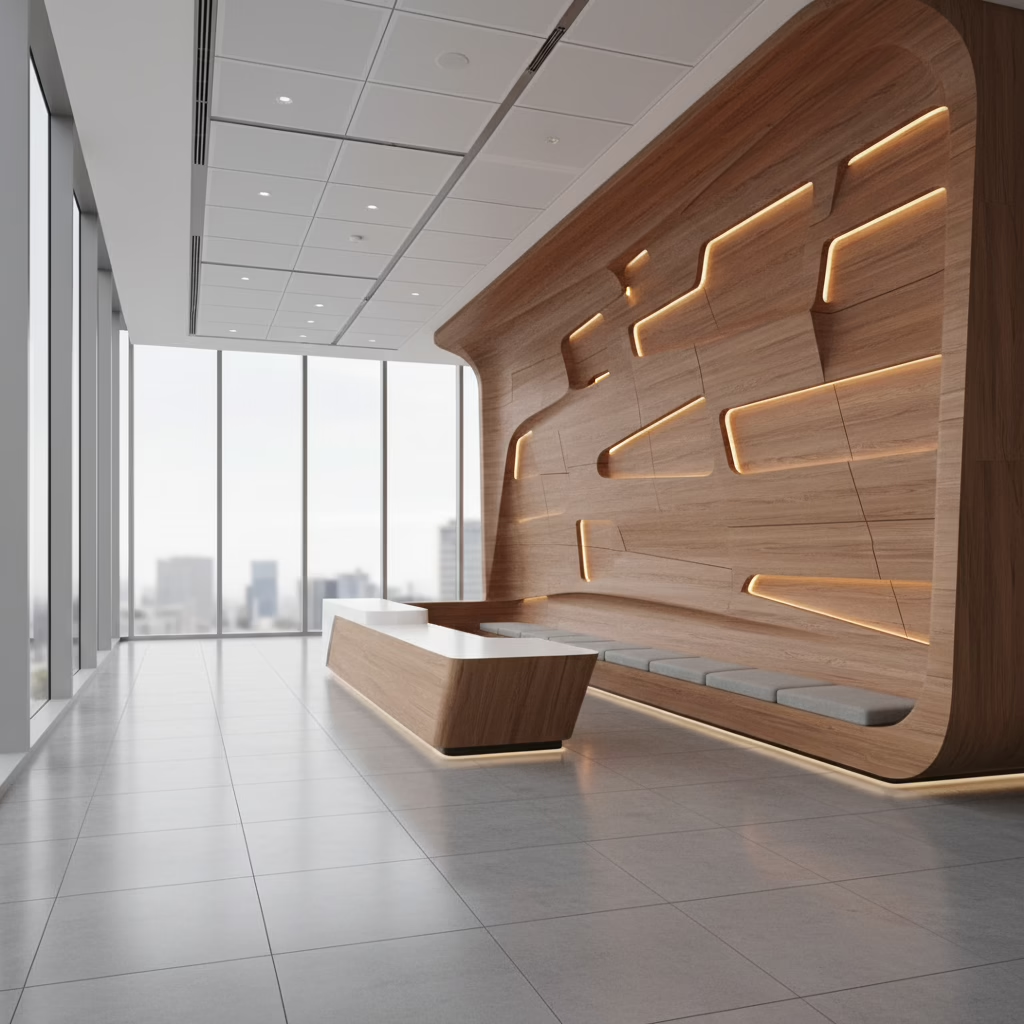
Custom commercial millwork is the tailored design, fabrication, and installation of architectural woodwork for business interiors. It covers reception desks, wall panels, casework, and built-ins engineered to brand standards and daily use. From 11 Edvac Drive, our in-house team delivers end-to-end millwork that fits code, looks refined, and works hard.
By Ashok — Altima Kitchens and Closets
Last updated: May 8, 2026
Overview: Custom Commercial Millwork at a Glance
Custom commercial millwork turns empty rooms into branded, high-function spaces. Think reception desks, meeting credenzas, retail fixtures, and durable storage built to spec. This overview maps the full journey—strategy, design, manufacturing, finishing, and installation—so you can plan confidently and avoid costly rework.
Here’s how this complete guide helps you plan and execute a successful project with a one-stop partner like Altima:
- Define what millwork includes (and what it doesn’t) for offices, clinics, retail, and hospitality.
- See how a design-build workflow with in-house manufacturing reduces risk.
- Review materials, finishes, and hardware with real-world pros and cons.
- Follow a step-by-step process you can hand to your team.
- Learn how Altima’s factory-direct cabinetry and spray-booth finishing raise quality.
- Use checklists to avoid timeline slips and change-order churn.
At a glance: table of contents
- What Is Custom Commercial Millwork?
- Why Custom Millwork Matters for Businesses
- How Custom Millwork Projects Work (Step-by-Step)
- Types of Commercial Millwork and Casework
- Design and Material Best Practices
- Tools, Standards, and Resources
- Case Studies and GTA Examples
- Frequently Asked Questions
- Conclusion and Next Steps
What Is Custom Commercial Millwork?
Custom commercial millwork is purpose-built architectural woodwork—reception stations, wall panels, fixtures, and storage—fabricated to drawings for business interiors. Unlike off-the-shelf casework, it matches your brand dimensions, traffic loads, and maintenance needs, then installs cleanly to integrate mechanical, electrical, and data requirements.
Millwork is the architectural layer that makes a commercial interior feel designed, not assembled. It includes:
- Reception desks and concierge pods with integrated lighting, cable routing, and durable worktops.
- Wall paneling and feature walls that hide wiring, improve acoustics, and elevate brand presence.
- Conference storage and credenzas sized to AV gear, sample kits, and hospitality supplies.
- Retail fixtures and displays that balance visual merchandising with stock access and security.
- Clinics and labs casework designed for hygiene, chemical resistance, and clear labeling systems.
Where does it stop? Millwork is distinct from structural framing and MEP. It partners with those trades, but its job is the precision-crafted, visible layer that people touch every day. That’s why our in-house designers develop 2D/3D drawings before we cut a single panel on our Italian CNC line.
For teams planning multiple spaces, our commercial renovation services connect millwork with flooring, tiles, lighting, and more to streamline your rollout.
Why Custom Millwork Matters for Businesses
The right millwork improves first impressions, workflow, and durability. It speeds daily tasks, reduces maintenance, and reflects your brand. When engineered with factory-direct controls and professional finishing, millwork becomes a long-term asset—not a punch-list liability.
Here’s why decision-makers prioritize custom work over generic fixtures:
- Brand consistency: Color, grain, reveals, and lighting align with your standards across locations.
- Operational fit: Drawers, pull-outs, and grommets go where your team actually needs them.
- Longevity: Industrial-grade substrates and finishes resist dents, spills, and UV better than consumer cabinetry.
- Clean installation: Shop-built precision cuts down on field improvisation and downtime.
- Safety and hygiene: Rounded corners, wipeable surfaces, and sealed edges support safer, cleaner spaces.
In our experience, the fastest ROI comes from areas with constant contact—receptions, checkout counters, nurse stations, and breakrooms. We frequently pair millwork with custom kitchen cabinets for staff areas and custom closet design for back-of-house storage so operations run smoother from day one.
How Custom Millwork Projects Work (Step-by-Step)
Successful millwork follows a clear path: discovery, measured survey, 2D/3D design, engineering, fabrication, finishing, logistics, and installation. With one accountable team handling each handoff, schedules stabilize and site risk drops. That’s the advantage of Altima’s design-build, factory-direct approach.
Step-by-step workflow
- Discovery and goals: Align on brand intent, traffic patterns, storage needs, and compliance requirements.
- Site measure: Verify walls, floors, and services so shop drawings match real conditions.
- 2D/3D design: Review layouts, clearances, finishes, lighting, and hardware before fabrication.
- Engineering: Produce CNC-ready files, select substrates/veneers, and detail edge treatments.
- Fabrication: Machine parts on Italian CNC equipment; assemble with precision jigs.
- Finishing: Apply professional coatings in a controlled spray booth for consistency.
- Logistics: Protect, label, and stage components for just-in-time delivery.
- Installation: Fit, level, scribe, and fasten; integrate MEP and perform a quality walk.
| Phase | Primary Output | Owner Action | Risk Reduced |
|---|---|---|---|
| Discovery | Requirements brief | Share workflows/brand specs | Misaligned goals |
| Measure | Verified dimensions | Grant site access | Field rework |
| Design | 2D/3D drawings | Approve drawings | Late changes |
| Engineering | CNC files, cut lists | Confirm materials | Fabrication errors |
| Fabrication | Built components | Review progress | Quality variance |
| Finishing | Sealed surfaces | Sign off samples | Color mismatch |
| Install | Fit-out complete | Coordinate access | Schedule drift |
We coordinate early with your GC, security vendor, and IT so cutouts and cable paths are right the first time. For multi-site clients across the GTA, our process templates and labeling system speed repeatability while protecting finish quality.
Local considerations for 11 Edvac Drive
- Plan deliveries and staging with your building’s loading policies to keep millwork protected and on schedule.
- Winter and shoulder seasons bring moisture swings; we acclimate materials on site to stabilize panel seams and doors.
- Coordinate after-hours installation windows to minimize disruption in busy commercial corridors around Brampton and the GTA.
For broader build planning, this overview of commercial construction considerations highlights coordination needs you’ll recognize during millwork fit-out.

Types of Commercial Millwork and Casework
Commercial millwork spans reception desks, panel systems, built-ins, and specialty fixtures. Casework covers modular, repeatable cabinets. Blending both keeps budgets predictable while reserving true custom work for brand-critical touchpoints like lobbies and client-facing rooms.
Common categories we deliver
- Reception and concierge: Tiered counters, integrated lighting, tamper-resistant grommets, and ADA-style knee clearances as required by your jurisdiction.
- Conference and training rooms: Credenzas for AV gear, sliding-door storage, markerboard walls, and discreet waste pull-outs.
- Retail fixtures: Modular shelving, nesting tables, and lockable drawers with branded accent reveals.
- Healthcare and labs: Chemical-resistant counters, easy-wipe panels, and labeled drawer inserts.
- Staff kitchens and breakrooms: Durable casework, integrated appliances, and backsplash details that hold up to daily use.
- Back-of-house storage: Adjustable shelving, mobile carts docks, and bulk storage with reinforced bottoms.
Material and system approaches
- High-pressure laminate (HPL): Excellent wear resistance for counters and drawer faces; vast color range.
- Thermally fused laminate (TFL): Efficient for interior surfaces and case bodies; consistent textures.
- Veneer on engineered core: Real-wood depth with stable cores; specify matching edge treatments.
- Solid surface and quartz: Seamless joints, food-safe options, and easy cleaning in staff kitchens.
- Metal accents: Powder-coated trims and toe-kicks for impact zones.
For brand-forward details, our CNC door profiles and reveal strategies create consistency across locations without sacrificing speed to open.

Design and Material Best Practices
Design millwork from the user outward: flows, reach zones, cleaning routines, and service access. Then lock finishes and hardware that handle daily impact. Early 2D/3D reviews save weeks later, especially when matching lighting, reveals, and cable paths to engineered cutouts.
Design essentials we validate in 2D/3D
- Circulation and reach: Door swings, pull ranges, and queueing zones are modeled before anything is cut.
- Service integration: Power/data grommets, under-cab lights, and ventilation are engineered into the drawings.
- Cleaning strategy: Choose wipe-friendly corners, sealed edges, and lift-off panels where maintenance access matters.
- Acoustics: Slat walls, perforated panels, and soft backers reduce echo in open lobbies.
- Hardware: Soft-close slides, hinges rated for commercial cycles, and anti-theft locks where needed.
Finish and substrate guidance
- High-touch fronts: Favor HPL or tough paint systems from our spray booth to limit scuffs.
- Wet zones: Specify quartz or solid surface with sealed backsplashes and silicone management.
- Sun-exposed areas: Ask for UV-resilient finishes and color-stable laminates.
- Hidden interiors: Use TFL or melamine for cleanability and budget control.
We often combine brand-facing veneer panels with HPL in heavy-traffic zones. That mix offers warmth where it’s seen and ruggedness where it’s used. For staff kitchens, see our integrated custom kitchen cabinetry approach to keep appliances, sinks, and backsplashes coordinated.
Tools, Standards, and Resources
Quality millwork depends on the right tools and standards: CNC machining, professional spray finishing, and clear shop drawings anchored to recognized quality benchmarks. When teams use shared templates for edging, reveals, and fasteners, projects repeat cleanly across multiple sites.
Inside our Brampton facility, we manufacture with Italian CNC machinery for precise parts, then finish in a controlled spray booth for color and sheen consistency. We align shop drawings to recognized quality expectations and document hardware and fasteners for repeatability.
- Tooling: Industrial CNC, edgebanders, calibrated clamps, dust extraction, and finishing booths.
- Documentation: Shop drawings with section cuts, hardware schedules, and finish keys.
- Quality checks: Dimensional checks at assembly, finish inspection, and on-site punch-list closeout.
For context on broader build coordination, review this primer on commercial construction phases and notice how millwork ties into electrical and mechanical handoffs. And for ventilation-sensitive environments like food service, see practical notes in this air quality in commercial kitchens guide when planning cabinetry clearances and make-up air.
Cross-trade coordination matters. For example, plumbing rough-ins behind base cabinets and sinks must land exactly where cutouts are specified. This storage project example illustrates how shop work and site services meet without last-minute improvisation.
Case Studies and GTA Examples
Well-executed millwork blends brand presence with day-to-day durability. These GTA scenarios show how our design-build model simplifies decisions, compresses schedules, and raises finish quality across different business types.
Office lobby and meeting suite
- Challenge: Create a welcoming lobby that manages guest flow and conceals wiring.
- Solution: Custom reception with integrated lighting and cable routing, wall panels with acoustic backing, and AV-ready credenzas.
- Outcome: Faster check-ins and quieter meetings with minimal visible cabling.
Details like reveal spacing and toe-kick protection made the difference. We often amplify results with custom built-ins that unify storage and brand elements in a single, coherent wall.
Healthcare reception and treatment rooms
- Challenge: Durable, hygienic surfaces that withstand frequent cleaning.
- Solution: HPL fronts, chemical-resistant counters, sealed edges, and lift-off access panels for maintenance.
- Outcome: Easier sanitation routines and fewer service calls thanks to clear access points.
Retail display run and stock wall
- Challenge: Balance visual merchandising with fast restocking.
- Solution: Modular shelving with protected edges and lockable drawers; integrated lighting for product highlights.
- Outcome: Quicker resets and less damage to corners in high-traffic zones.
Staff kitchen and breakroom
- Challenge: Heavy daily use and water exposure around sinks and dishwashers.
- Solution: Quartz counters, HPL fronts, clear backsplash transitions, and appliance ventilation pathways.
- Outcome: Cleaner counters, less warping, and a space teams actually enjoy using.
For multi-location programs, our Oakville commercial renovation experience shows how we maintain finish standards across different suites while adapting to each site’s quirks.
Frequently Asked Questions
These quick answers cover scope, timelines, finishes, and coordination for custom commercial millwork. Use them to align your stakeholders before design kickoff and avoid avoidable changes after fabrication begins.
What’s the difference between millwork and casework?
Millwork is custom architectural woodwork built to specific drawings—think reception desks and feature walls. Casework is modular cabinetry made in standard sizes. Many projects blend both: casework for repeatable storage, millwork for brand-critical areas.
How do you ensure my drawings reflect site reality?
We perform a measured survey before engineering. That data flows into 2D/3D drawings, which you approve. Only then do we generate CNC files. The result is shop-built parts that actually fit your walls, floors, and service locations during install.
What finishes hold up best in high-traffic areas?
High-pressure laminate (HPL) front faces and quartz or solid-surface countertops perform very well. We also recommend commercial-rated hinges and slides, sealed edges, and toe-kick protections to minimize scuffs and moisture intrusion.
Can you coordinate with our GC and IT vendor?
Yes. We coordinate early with your general contractor, security vendor, and IT for cutouts, cable pathways, and access panels. Clear handoffs reduce field improvisation and keep schedules predictable during installation.
Do you offer drawings and visualizations before fabrication?
Absolutely. Our process includes 2D drawings and 3D visualizations so you can see proportions, reveals, and finish transitions ahead of time. Approvals at this stage prevent costly changes once materials are cut.
Conclusion and Next Steps
Custom commercial millwork delivers branded impact and everyday durability when it’s planned, engineered, and installed by one accountable team. With factory-direct controls and spray-booth finishing, Altima turns drawings into spaces that look sharp and work smoothly from day one.
Key takeaways
- Blend custom millwork with modular casework to target budgets without giving up brand moments.
- Lock decisions in 2D/3D before fabrication to protect timelines and finish quality.
- Engineer for cleaning, access, and service paths—not just looks.
- Use factory-direct partners to control quality from cut file to final wipe-down.
Action steps
- Schedule a discovery session to align on scope, finishes, and milestones.
- Book a measured survey so drawings reflect your real site conditions.
- Review 2D/3D options and finalize materials in our showroom workflow.
Ready to plan branded, durable interiors? Start with our commercial renovation team or explore custom built-ins for receptions, meeting rooms, and retail walls across the GTA.
Related Posts
Why Choose Kitchen Renovation Company
Nowadays, Kitchen spaces are not only a place for cooking and serving food, but these areas act as a statement, as they speak a lot about a family, the philosophy and personality of individuals, and spaces. If you admire aesthetics and adorn the beauty of your home, you must pay attention to the interior design […]
How a Kitchen Renovation Contractor is Changing the Game
Lifestyle is all about bringing something coherent to the overall experience of living. The kitchen and closets stand as two of the most influential spaces in a home that add to the overall experience of living. A Kitchen Renovation Contractor in Whitby by the name of Altima Kitchen and Closets Inc. is changing the overall […]
How Media unit contractor in Whitby is Changing the Game
Lifestyle is all about bringing something coherent to the overall experience of living. The kitchen and closets stand as two of the most influential spaces in a home that add to the overall experience of living. A Media Unit Company in Whitby by the name of Altima Kitchen and Closets Inc. is changing the overall […]