CNC Cabinet Profiles: Pick Better Styles for 2026
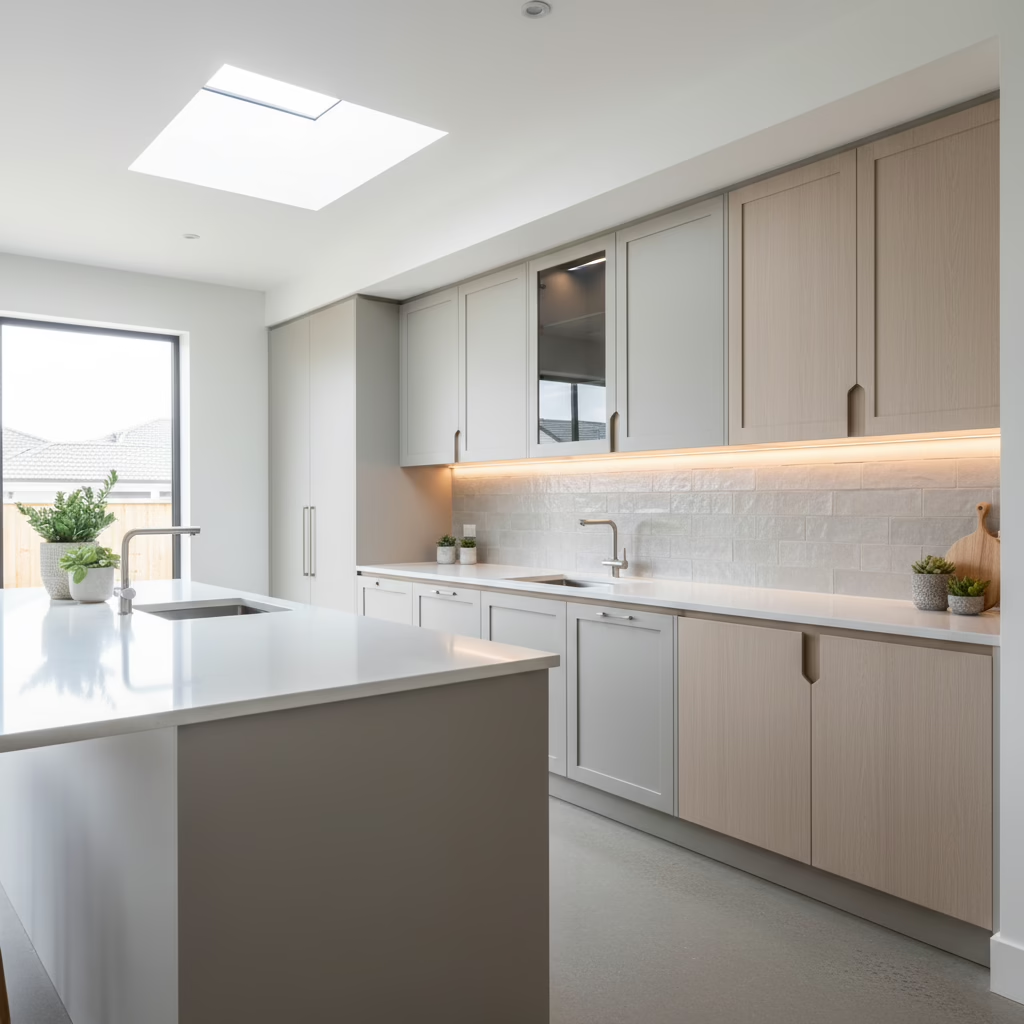
CNC cabinet door profiles (modern) are precisely machined edge and panel shapes created on computer-controlled routers. They deliver clean lines, consistent tolerances, and reliable hardware alignment. At Altima Kitchens and Closets in 11 Edvac Drive, we design, mill, finish, and install these profiles to elevate GTA kitchens and condos with lasting performance.
By Ashok — Altima Kitchens and Closets
Last updated: 2026-04-23
At a Glance: Modern CNC Cabinet Door Profiles
Modern CNC cabinet door profiles are the exact edge, rail, stile, and panel geometries milled by a CNC router to define how doors look, feel, and perform. Slab, slim Shaker, beveled, and integrated J-pull styles dominate today’s minimalist kitchens, balancing easy cleaning with precise, repeatable fit for hinges and slides.
Here’s what you’ll learn and be able to decide confidently by the end:
- What “modern” CNC cabinet door profiles are and how they differ from traditional routing
- Why certain profiles clean faster, resist wear better, and align more reliably
- How CNC profiling works from 2D/3D design to spray-finished doors
- Which profile types suit condos vs. detached homes across the GTA
- Actionable best practices for rail widths, reveals, coatings, and hardware
- How Altima’s in-house CNC and finishing workflow reduce risk and delays
Quick Summary
- Primary trend: slimmer rails (1.5–2.25 inches), flush edges, and handleless J-pulls
- Technical constant: accurate reveals (about 2 mm) and stable 3/4-inch door thickness
- Material logic: MDF for painted smoothness; maple or rift white oak for stain
- Finish recipe: primer + 2–3 topcoats to ~3–4 mil dry film for durability
- Hardware pairing: 35 mm hinge cups, 110° soft-close hinges, full-extension slides
Table of contents
- What is a modern CNC cabinet door profile?
- Why profiles matter in contemporary kitchens
- How CNC door profiling works (step-by-step)
- Types of modern CNC profiles (visual glossary)
- Best practices for selecting profiles, materials, and finishes
- Tools, resources, and Altima workflow
- GTA case studies and real-world examples
- FAQ: modern CNC cabinet door profiles
- Key takeaways
- Conclusion and next steps
Local considerations for 11 Edvac Drive
- Plan milling and delivery schedules around condo rules and elevator bookings common across the GTA; we coordinate these as part of our in-house project management.
- Winter installs require acclimating doors for 48–72 hours at 30–50% RH to minimize seasonal movement before hinge adjustment.
- Weekday traffic windows can affect on-site timings; our showroom/factory workflow near 11 Edvac Drive shortens turnaround between design approvals and production.
What Is a Modern CNC Cabinet Door Profile?
A modern CNC cabinet door profile is the precise shape cut into a door’s panel and edges by a computer-controlled router. This geometry governs the door’s style, cleaning behavior, and fit. Today’s profiles favor flat slabs, slim Shaker rails, bevels, and integrated pulls that read clean and align hardware accurately.
In plain terms, the “profile” is the cross-section you’d see if you sliced through the door or rail. It includes edge treatments, panel recesses, and any integrated pulls. On modern projects, tight reveals (~2 mm), 3/4-inch (19 mm) door thickness, and crisp corners are nonnegotiable for that seamless look.
Because Altima designs and manufactures in-house with Italian CNC machinery and a professional spray booth, we hold consistent tolerances from CAD file to installed hinge. That start-to-finish control reduces the common homeowner pain points: misaligned doors, uneven gaps, and finish mismatch across batches.
If you’re evaluating manufacturers, see our guidance on selecting kitchen cabinet manufacturers to understand how tooling, finishing, and QC shape long-term results.
Why Profiles Matter in Contemporary Kitchens
Profiles affect daily use, durability, and the overall aesthetic. Slim rails clean faster, integrated pulls reduce protrusions, and consistent CNC milling keeps doors aligned through humidity swings. The right profile pairs with soft-close hardware, protects finish edges, and supports a timeless, modern look.
Here’s why this choice has outsized impact:
- Cleaning time: Shallower recesses and fewer grooves trap less dust and grease. Many homeowners report faster wipe-downs when moving from ornate to slim-rail Shaker or slab.
- Edge resilience: A slight bevel or eased edge prevents chipping on high-touch corners without changing the modern read.
- Hardware harmony: Profiles designed around 35 mm hinge cups and full-extension slides let doors and drawers open to their full 110°/100% travel cleanly.
- Seasonal stability: With proper acclimation and 30–50% indoor RH, CNC-cut parts maintain reveals better than hand-routed pieces with inconsistent passes.
In our experience across the GTA, the most satisfied clients choose a profile that supports their daily routine. For example, a handleless J-pull near dishwashers prevents clothing snags, while a slim Shaker face makes crumbs and splashes easy to spot and clean.
Thinking about refreshing existing boxes? Our resource on painting kitchen cabinets: process overview explains when repainting and new doors can align to achieve a cohesive modern result.
How CNC Door Profiling Works (Step-by-Step)
Modern door profiling converts a 2D/3D design into CNC toolpaths, secures material on a vacuum table, and mills edges and panels with compression and downcut bits. Parts are sanded, primed, and topcoated in a spray booth, then paired with 35 mm soft-close hinges and full-extension slides during installation.
Here’s the end-to-end workflow we run at Altima’s Brampton-area showroom and factory:
- Design and approvals: We translate your 2D/3D kitchen design into nested door sizes, profiles, and reveals. Typical door thickness is 3/4 inch; finger rails target 20–30 mm depth for comfortable grip.
- Material prep: Panels are cut to size and labeled. Painted doors often use engineered MDF for a glass-smooth finish; stained projects favor maple or rift white oak for linear grain.
- Tooling and fixturing: Compression bits reduce tear-out; downcut bits keep top edges crisp. Vacuum pods or a spoilboard hold parts flat so edges remain square within tenths of a millimeter.
- Profiling and boring: Door edges, panels, and hinge cups (35 mm) are milled in one program sequence. We set hinge offsets so a 110° soft-close swing clears adjacent faces.
- Sanding and finishing: Surfaces are prepped, primed, and topcoated to ~3–4 mil dry film. Eased edges reduce chipping on high-use corners while staying visually sharp.
- Assembly and QA: We test reveals around 2 mm and run drawers on full-extension slides (18–21 inches, project-dependent). Final hardware is torqued and rechecked on site.
Curious about the machining environment? Our integrated shop keeps milling, finishing, and assembly under one roof, which cuts days from handoffs and avoids finish mismatches across batches. That’s a key advantage of our factory-direct model.

Types of Modern CNC Profiles (Visual Glossary)
Modern CNC profiles cluster around slabs, slim-rail Shaker variants, softened bevels, and integrated J-pull or finger-rail systems. Each type balances styling, cleaning ease, hardware compatibility, and ergonomics. The best choice matches ceiling height, appliance scale, and whether you want handles or a true handleless feel.
Below is a practical glossary with quick-fit guidance you can apply during design reviews.
Core modern profiles
- Slab (flat): Ultra-clean plane; ideal for minimalist and Scandinavian reads. Pairs with slim pulls or push-latch. Fastest to clean.
- Slim Shaker (narrow rails ~1.5–2.25 in): Modern take on classic; reads lighter. Good for small condos that need visual simplicity.
- Classic Shaker (2.5–3 in rails): Balanced, timeless; still works in modern schemes with low-sheen finishes and minimal hardware.
- Mitered Shaker: Rails meet at 45°; crisp, furniture-grade detail in stain-grade species like rift white oak.
- Beveled edge: Subtle 1–2 mm bevel softens wear-prone edges without losing the straight-line aesthetic.
- Cove edge: Gentle concave edge for a softer, transitional read with easy dusting.
- Integrated J-pull: Machined pull lip (often ~5/8 in) on door/drawer top; deliver true handleless fronts and reduced projection.
- Finger rail: A separate continuous rail recessed behind the door top; creates a linear, shadowed grip line.
- Recessed panel micro-step: Thinner panel step for a tighter, modern Shaker look.
Comparison table: where each profile shines
| Profile | Style read | Cleaning | Hardware pairing | Best fit |
|---|---|---|---|---|
| Slab | Minimalist, seamless | Fastest (no grooves) | Push-latch or slim pulls | Condos, tight kitchens |
| Slim Shaker | Modern classic | Quick (shallow step) | Bar pulls, knobs | Open-plan family homes |
| J-pull | Handleless, linear | Fast (no hardware) | Integrated pull lip | Streamlined galley runs |
| Bevel/Cove | Soft modern | Easy (eased edges) | Any soft-close set | High-traffic zones |
If you’re updating only doors and not boxes, check our guidance on where to buy cabinet doors only so hinge cups and reveals line up correctly with your existing cases.

Best Practices for Selecting Profiles, Materials, and Finishes
Match profile scale to your space, pick materials by finish intent (MDF for paint, maple/oak for stain), and protect edges with subtle bevels. Target ~2 mm reveals, 3/4-inch door thickness, and soft-close hardware. Finish with primer plus 2–3 coats to ~3–4 mil dry film for durability.
Scale the profile to the room
- Ceiling height: 9–10 ft ceilings tolerate slightly wider rails; 8 ft rooms favor slim rails to keep doors light and vertical lines strong.
- Appliance scale: Oversized refrigerators and ranges look balanced with thicker rails; compact appliances bond with slim rails and slabs.
- Door thickness: Standard 3/4 inch suits most projects; specialty 7/8 inch adds heft on tall pantry doors.
Choose materials by finish goal
- Painted modern looks: MDF delivers a remarkably smooth, pore-free surface. It’s also stable for crisp micro-steps in Shaker variants.
- Warm, natural reads: Maple or rift white oak showcase linear grain that reinforces modern lines under low-sheen topcoats.
- Edge protection: A 1–2 mm bevel resists chipping on high-touch corners while maintaining a sharp silhouette.
Dial in the finish system
- Build a durable film: Primer plus 2–3 topcoats typically lands around 3–4 mil dry film, a sweet spot for durability in busy kitchens.
- Sheen level: Matte to satin hides fingerprints better than high gloss while staying modern.
- Color strategy: Pair warm whites with rift oak accents, or contrast graphite lowers with white uppers and bright task lighting.
Hardware and reveals that behave
- Hinges: 35 mm cup hinges at 110° are the modern default. Use 155° at corners to prevent door-to-door collisions.
- Drawers: Full-extension undermount slides at 18–21 inches maximize access; soft-close dampers protect finish edges.
- Reveals and gaps: Around 2 mm between doors/drawers reads refined and reduces rub-through. Plan a consistent 3/32–1/8 inch from fronts to side gables.
For a deeper style refresh around existing wood tones, our guide on how to make oak cabinets look modern covers finishes, lighting, and hardware that harmonize with today’s profiles.
Tools, Resources, and Altima Workflow
Altima brings design, CNC milling, finishing, and installation under one roof. You get showroom samples, 2D/3D drawings, factory-direct production, and coordinated accessories—spice pull-outs, lazy Susans, and pull-out pantries—so your chosen profile integrates cleanly with lighting and storage from day one.
What you can expect when working with our team:
- 2D/3D design previews: Visualize rail widths, J-pull lips, and edge easing before we cut a single panel.
- Showroom samples: Handle slab, slim Shaker, and J-pull doors in person to feel grip depth and see sheen behavior under lighting.
- Factory-direct control: Our Italian CNC line and spray booth keep your finish consistent across batches and timelines.
- Accessories matched to profiles: We integrate spice rack pull-outs, lazy Susan cabinets, and pull-out pantries that clear modern edges without interference.
- Structured updates: You’ll receive organized communication throughout the project, aligning design approvals with production windows.
For whole-home organization around the kitchen, explore our approach to custom wardrobe closets and see how our end-to-end process carries across rooms for a coherent, modern home.
GTA Case Studies and Real-World Examples
Across GTA kitchens and condos, modern CNC profiles consistently improve day-to-day function. Slab and slim-rail Shaker reduce cleaning time, while J-pulls eliminate hardware projection along narrow aisles. In our projects, accurate reveals and soft-close hardware help doors stay aligned through seasonal humidity swings.
Condo galley with J-pulls
A downtown condo needed a handleless look to keep a 36-inch aisle obstruction-free. Integrated J-pull doors and drawers with a ~5/8-inch pull lip eliminated snags near the dishwasher. Soft-close slides and a satin finish kept the space calm and practical.
Family kitchen with slim Shaker
In a busy open-plan kitchen, slim-rail Shaker balanced warmth and modernity. We specified 1.75-inch rails, 3/4-inch thickness, and a 1 mm bevel on edges to resist micro-chips. Full-extension slides improved access to deep pots near the range.
Rift oak slab for warmth
A homeowner wanted a modern aesthetic without an all-white scheme. Rift white oak slab lowers under matte white uppers delivered visual rhythm. The linear grain reinforced long runs and paired beautifully with warm under-cabinet lighting.
If you’re also planning a mudroom or entry upgrade, our mudroom cabinet plan shows how the same modern lines carry into high-traffic storage zones.
For condo-specific constraints and coordination, visit our Mississauga condo renovation overview to see how we handle approvals, elevator bookings, and quiet-hour policies while maintaining timelines.
FAQ: Modern CNC Cabinet Door Profiles
Modern CNC cabinet profiles emphasize slim rails, smooth edges, and reliable hardware fit. Choose MDF for painted doors and maple or rift oak for stain. Target ~2 mm reveals and 3/4-inch thickness. J-pulls create a handleless look; slim Shaker balances classic proportions with modern simplicity.
What is the most modern cabinet door profile right now?
Slab and slim-rail Shaker lead modern projects, with integrated J-pulls close behind for a true handleless look. These styles keep lines clean, minimize dust-trapping grooves, and pair well with soft-close hardware and low-sheen finishes.
Are MDF doors durable for modern painted kitchens?
Yes—when properly engineered and finished. MDF excels for painted doors because it’s smooth and stable. With primer plus 2–3 topcoats to about 3–4 mil dry film and eased edges, MDF doors stand up well to daily use and routine cleaning.
Will integrated J-pull doors work near dishwashers and fridges?
They do, and often better than protruding handles in tight aisles. Plan a comfortable pull depth (around 20–30 mm on a finger rail or ~5/8 inch on a J-pull lip) and verify appliance clearances during design to avoid collisions.
How do I maintain reveals and alignment over time?
Acclimate doors 48–72 hours before install, target indoor humidity between 30–50%, and use quality 35 mm soft-close hinges and full-extension slides. After the first few weeks, a quick hinge micro-adjust usually sets gaps for the long haul.
Key Takeaways
Choose a profile that matches your space, finish goal, and routine. Favor slim rails or slabs for fast cleaning; consider J-pulls for handleless runs. Lock in 3/4-inch thickness, ~2 mm reveals, soft-close hardware, and a robust spray finish for a modern kitchen that lasts.
- Modern = slimmer rails, clean edges, consistent reveals
- MDF for paint; maple or rift oak for stain
- Plan hinge cups (35 mm) and full-extension slides early
- Finish to ~3–4 mil dry film; aim for matte to satin sheen
- Use eased bevels (1–2 mm) to protect high-touch edges
Conclusion and Next Steps
The right CNC cabinet door profile delivers modern style you’ll enjoy every day—plus reliable cleaning and hardware behavior. With design, CNC, finishing, and installation under one roof, Altima makes profile selection simple and execution predictable from sample to final reveal.
Ready to see and feel your options? Book a design session at our Brampton-area showroom to compare slab, slim Shaker, and J-pull samples, confirm rail widths, and preview lighting and accessories in 2D/3D. We’ll align your selections with timelines and our in-house production windows.
Free design walkthrough: Bring your appliance list and room dimensions. We’ll map profile options, hinge positions, and reveals on the spot, then follow with itemized selections and drawings for sign-off.
As you plan finishes around cabinetry, basic ventilation and dust control are essential in any workshop environment; see this overview on air quality improvements for practical context when evaluating finishing spaces. And for a quick primer on profile-related manufacturing terms, skim these special profiles for general terminology. Cabinet shoppers increasingly start online—Shopify’s cabinets resource illustrates this research trend and why detailed samples matter.
Related Posts
Why Choose Kitchen Renovation Company
Nowadays, Kitchen spaces are not only a place for cooking and serving food, but these areas act as a statement, as they speak a lot about a family, the philosophy and personality of individuals, and spaces. If you admire aesthetics and adorn the beauty of your home, you must pay attention to the interior design […]
How a Kitchen Renovation Contractor is Changing the Game
Lifestyle is all about bringing something coherent to the overall experience of living. The kitchen and closets stand as two of the most influential spaces in a home that add to the overall experience of living. A Kitchen Renovation Contractor in Whitby by the name of Altima Kitchen and Closets Inc. is changing the overall […]
How Media unit contractor in Whitby is Changing the Game
Lifestyle is all about bringing something coherent to the overall experience of living. The kitchen and closets stand as two of the most influential spaces in a home that add to the overall experience of living. A Media Unit Company in Whitby by the name of Altima Kitchen and Closets Inc. is changing the overall […]