Quartz Countertops: Stay Strong and Look Great in 2026
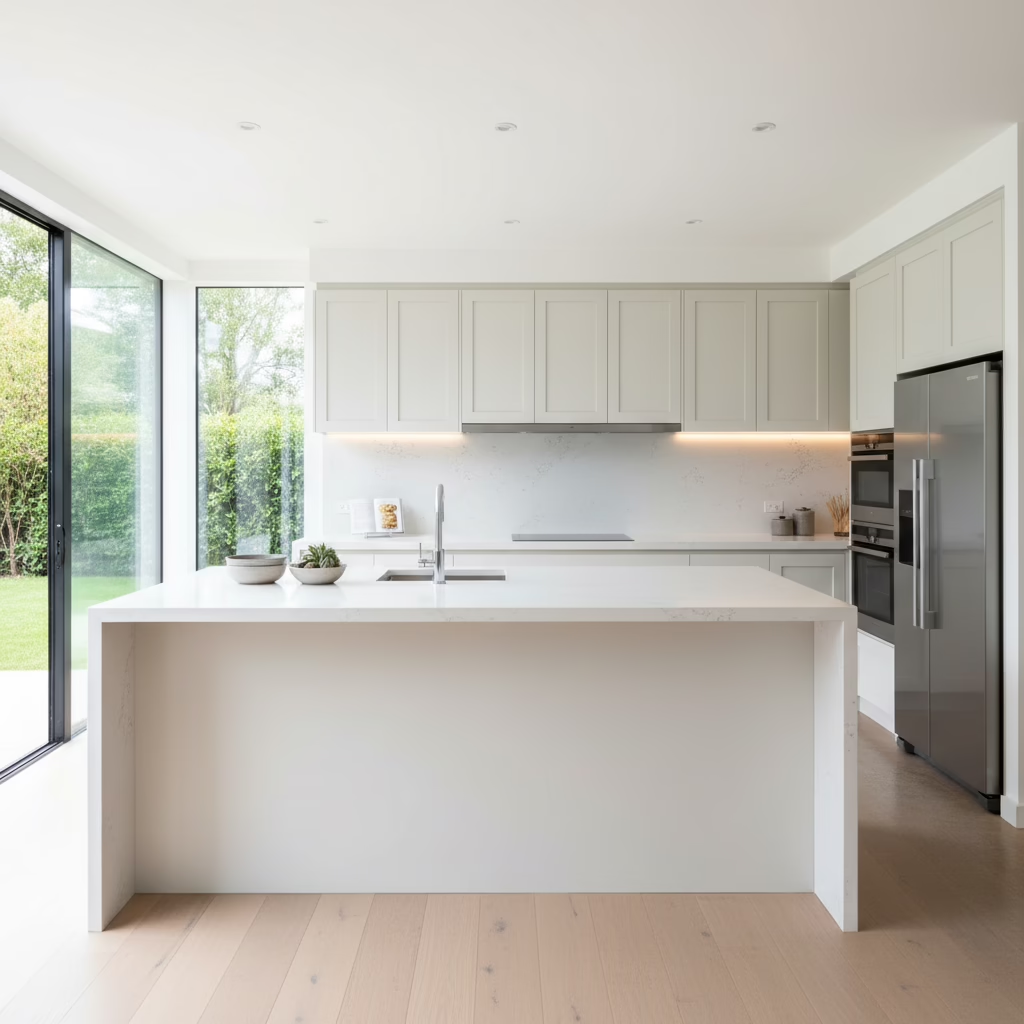
Quartz countertop benefits and durability come from a non-porous, engineered stone that resists stains, scratches, and chips better than most natural options. It requires no sealing, keeps color consistent, and stands up to daily cooking when you use trivets and cutting boards—ideal for busy family kitchens across the GTA.
By Ashok • Last updated: April 16, 2026
Quick Answer
Quartz countertop benefits and durability make quartz a top pick for modern kitchens. Its non-porous surface resists stains and bacteria, and consistent slabs simplify design. At our Brampton showroom (11 Edvac Drive), Altima Kitchens and Closets designs, templates, fabricates, and installs quartz for a seamless, end-to-end upgrade.
Summary
Quartz is an engineered surface—typically ~90–93% ground quartz bound with resins—that delivers non-porous, stain-resistant, and scratch-resistant performance. It never needs sealing, offers predictable color/patterns, and fits high-traffic kitchens. Use trivets for hot cookware and cutting boards for knives to preserve the finish for years.
- What you’ll learn: A durability-first breakdown of quartz, an apples-to-apples comparison, and a practical buying path from our GTA team.
- Who it’s for: Toronto and GTA homeowners planning a kitchen renovation or refresh, including condo projects.
- Why Altima: In-house design, factory-direct cabinetry, quartz selection support, and professional installation—under one roof at 11 Edvac Drive.
Quick Comparison Table: Quartz vs. Popular Countertops
Choose quartz for non-porous, low-maintenance durability. Granite tolerates direct heat better but needs sealing. Marble brings timeless beauty with higher etch/stain risk. Porcelain panels are heat/UV tough and thin but can chip at edges. Match the material to your cooking habits, lighting, and cleaning preferences.
| Surface | Durability Highlights | Maintenance | Heat | Seams/Pattern |
|---|---|---|---|---|
| Quartz (engineered) | Non-porous; excellent stain/scratch resistance; Mohs ~7 | No sealing required; simple cleaning | Good; use trivets for hot pans | Consistent patterns; seams blend well |
| Granite | Very hard; good scratch resistance | Periodic sealing recommended | Better direct heat tolerance | Natural variation; seams more visible |
| Marble | Softer; prone to etching/stains | Frequent sealing and gentle cleaners | Fair; protect from heat | High variation; patina develops |
| Porcelain/Ultra-compact | High heat/UV tolerance; thin/light | Low maintenance | Excellent direct heat tolerance | Printed patterns; crisp seam work needed |
Here’s the thing: most GTA families want minimal upkeep without sacrificing style. In our experience, quartz balances toughness and everyday convenience better than almost anything else for indoor kitchens, especially when paired with smart edge profiles and a matching slab backsplash.
Our Top Pick: The Single Best Benefit of Quartz
The standout benefit is non-porous, sealed-for-life durability. Liquids and pigments don’t penetrate, so stains are far less likely and cleanup stays simple—soap and water do the job. For busy households, this “one-and-done” protection removes sealing and re-sealing from your maintenance list.
- Why it matters: Coffee, wine, tomatoes, and oils are common in active kitchens. With quartz’s near-zero absorption, messes stay surface-level.
- Example from Brampton: We recently installed light-toned quartz on a 9-foot family island. After weekly pizza nights, wipe-downs took minutes and the surface stayed spotless.
- Do this next: Combine an undermount sink with a full-height quartz backsplash to eliminate grout lines and speed up daily cleaning.
Quartz Countertop Benefits & Durability: 11 Reasons They Last
Quartz durability comes from the mineral’s hardness (Mohs ~7), a non-porous resin matrix, and factory-controlled consistency. The result: fewer stains, fewer chips, and easier upkeep than many natural stones—especially in high-traffic, multi-cook kitchens common across the GTA.
1) Non-Porous and Stain Resistant
- Liquids sit on the surface instead of soaking in—ideal for wine, coffee, and citrus.
- No periodic sealing, so protection doesn’t “wear off” between maintenance cycles.
- In our handovers, we see families get years of like-new performance with basic care.
Action step: keep a pH‑neutral cleaner and a soft microfiber cloth in a top drawer—quick access drives good habits.
2) Scratch and Chip Resistance
- Quartz’s mineral hardness helps resist utensil marks; it’s tougher than many natural stones in daily use.
- Eased or small-radius edges reduce chip risk at impact-prone corners.
- Use cutting boards—good for knives and preserves the polish.
Installer tip: we add small inside-corner radii (about 1/8–1/4 in) to spread stress and lower crack initiation risk.
3) Consistent Color and Veining
- Engineered composition yields predictable slabs across lots—great for long islands or U-shaped kitchens.
- Seams align more cleanly on uniform patterns, improving visual continuity.
- What you approve in the showroom closely matches what arrives—less guesswork.
Real-world: Consistency lets us extend a matching quartz top to a coffee bar months later with a near-perfect match.
4) Low Maintenance, No Sealing
- Eliminates annual sealing schedules entirely.
- Stable sheen and color with routine cleaning—no “blotchy” sealer wear.
- Hygienic by design—no porous network to harbor residue.
Clients often tell us the biggest surprise is how fast wipe-downs are after dinner rush—seconds, not minutes.
5) Hygienic Food-Prep Surface
- Non-porous construction minimizes bacterial absorption and lingering odors.
- Undermount sinks create a one-swipe transition—no lip to trap crumbs.
- Strategic seam placement keeps food-prep zones clean and simple.
FYI: Many quartz brands carry food-contact safety certifications (e.g., NSF/ANSI 51) for added peace of mind.
6) Edge Stability and Design Flexibility
- Profiles like eased, small bevel, and mitered waterfalls combine style and strength.
- 3 cm (about 1‑1/4 in) slabs provide rigidity for islands and spans.
- Waterfall ends protect cabinet gables from scuffs and spills.
Preview edges in 2D/3D: our team models overhangs, seams, and profiles so you can approve details before fabrication.
7) Colorfast Indoor Performance
- Modern resins and pigments hold indoor color under typical household lighting.
- Bright, sunlit spaces benefit from quartz’s consistent sheen vs. sealer-blotchy stones.
- UV caution: avoid outdoor use—some pigments can fade in direct sun.
Outdoor kitchens? We’ll steer you to UV-stable, weather-rated alternatives that match your design intent.
8) Heat Tolerance with Smart Habits
- Warm dishes are fine, but use trivets for hot pans to avoid thermal shock.
- Follow appliance clearances so oven and dishwasher heat doesn’t concentrate at edges.
- Air fryers and pressure cookers: park them on heat pads to be safe.
We add heat shields or gaskets where specs are tight to protect adjacent finishes.
9) Impact Resistance and Structural Support
- Quartz has strong flexural strength; level cabinets prevent point loads that can stress slabs.
- Overhangs beyond ~10–12 in typically need hidden brackets or corbels.
- Inside-corner radii reduce crack initiation—small details, big longevity.
Our installers laser-level bases within about 1/8 in across long runs so slabs sit flat and stress-free.
10) Seam Quality and Placement
- Uniform patterns allow tight seams (often ~1/16–1/8 in) that polish cleanly.
- Place seams away from cooktops/sinks and off main sightlines.
- Color-matched adhesives minimize visibility on light and veined designs.
During templating, we present a seam map so you can approve exact locations—no surprises on install day.
11) System Design: Sinks, Backsplashes, and Lighting
- Quartz integrates beautifully with undermount sinks and slab backsplashes for rapid cleanup.
- LED valance lighting accentuates sparkle on polished finishes; matte reads softer and hides fingerprints.
- Integrated drainer grooves and flush cooktop cutouts are achievable with experienced fabricators.
Because we manufacture cabinetry in-house, we align cabinet reveals, appliances, outlets, and quartz features to the millimeter.
How to Choose Durable Quartz for Your Kitchen
Match lifestyle to finish, thickness, and edge. Choose 3 cm slabs for rigidity, polished finishes for easy cleaning, and eased edges for chip resistance. Approve a seam map, plan support for 10–12 in overhangs, and confirm appliance clearances before fabrication to protect long-term durability.
Step-by-Step Selection
- Define use profile: Heavy cooking, kids, or frequent baking point to polished, consistent patterns that hide wear.
- Pick thickness: 3 cm for most kitchens; 2 cm with build-up in select, weight-sensitive designs.
- Approve edge: Eased or small-radius edges help durability at corners and seating overhangs.
- Check color under light: Review samples under your space’s daylight and evening lighting.
- Plan seams: Review the seam plan on your 2D/3D drawings; keep them out of focal zones.
- Confirm supports: Hidden brackets for extended overhangs; verify cabinet leveling across spans.
- Verify cutouts: Sink, faucet, air switch, soap dispenser, and cooktop per manufacturer specs.
Want help pairing surfaces with cabinets, floors, and backsplash tile? See our guidance on choosing the right materials early in planning.
Finish and Texture Guide
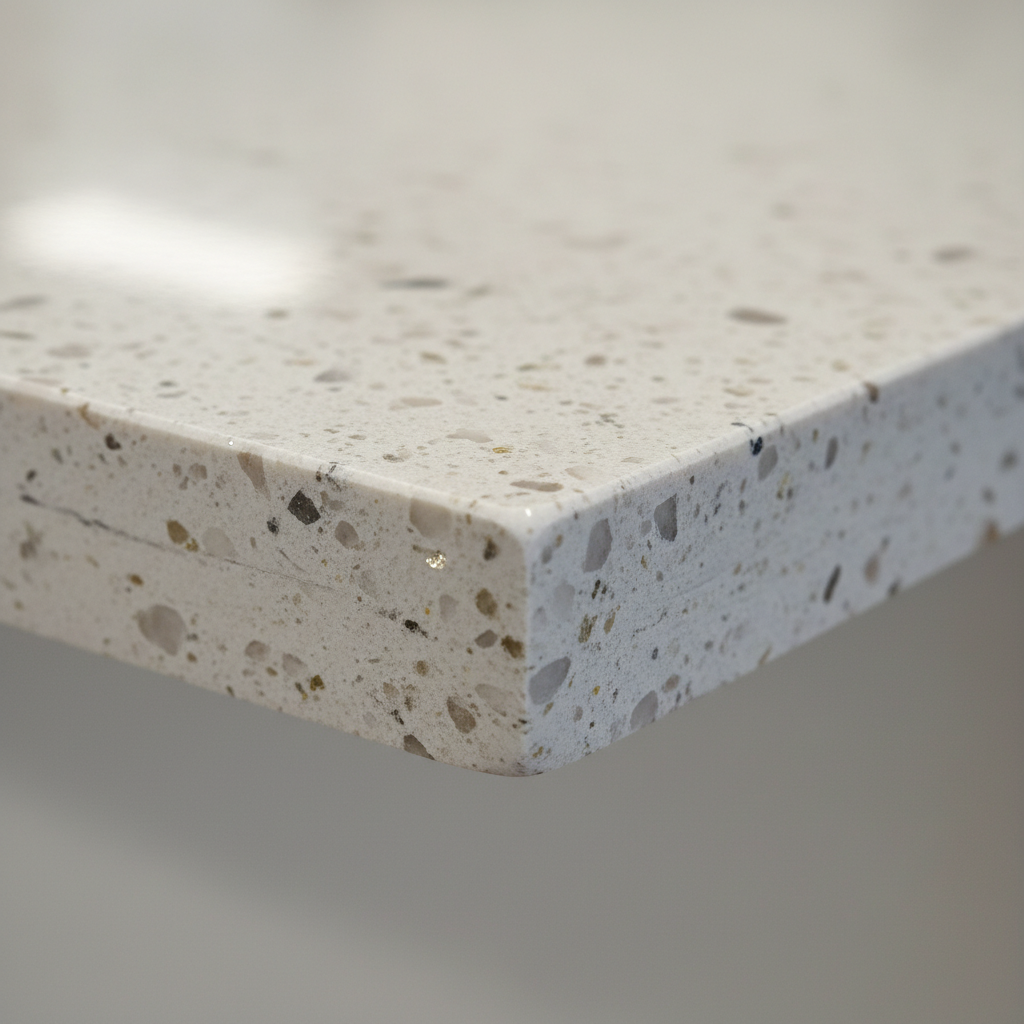
- Polished: Highest stain resistance and fastest wipe-downs; shows reflections and sparkle.
- Honed/Matte: Softer look; may show oils more readily; add a gentle, stone-safe cleaner.
- Textured: Hides smudges; may need a soft-bristle brush for crumbs in microtexture.
Durability note: finish doesn’t change the core non-porous structure, but it affects cleaning experience and how wear appears day to day.
Compatibility Checks
- Backsplash choice: Slab quartz = sleek and grout-free; tile = color/texture play. Plan outlet heights early.
- Sink style: Undermount stainless or composite sinks offer durable, easy-care performance.
- Appliance clearances: Follow spec sheets so heat and vibration don’t stress adjacent edges.
Cabinet, flooring, and surface choices should work together. If you’re early in planning, our post on picking kitchen flooring helps coordinate finishes and performance.
Soft CTA: Bring your cabinet door sample and floor swatch to our Brampton showroom. We’ll color-match quartz, show edge profiles, and preview everything in 2D/3D during one consult.
Buying Guide: From Showroom to Installation
A smooth quartz project follows a clear path: consult and measure, 2D/3D design, slab selection, templating, factory fabrication, professional installation, and a care walkthrough. Altima manages each stage in-house, aligning countertops with custom cabinetry for a precise fit.
Our Process at 11 Edvac Drive
- Showroom consult: Review samples, edges, sinks, and backsplashes with a designer.
- Site measure: Laser measurements and level checks; discuss seams and overhang supports.
- 2D/3D design: Visualize color, edge, and backsplash inside your exact layout.
- Templating: Create accurate templates; confirm cutouts and clearances from spec sheets.
- Fabrication: Precision CNC cutting and finishing in our factory workflow.
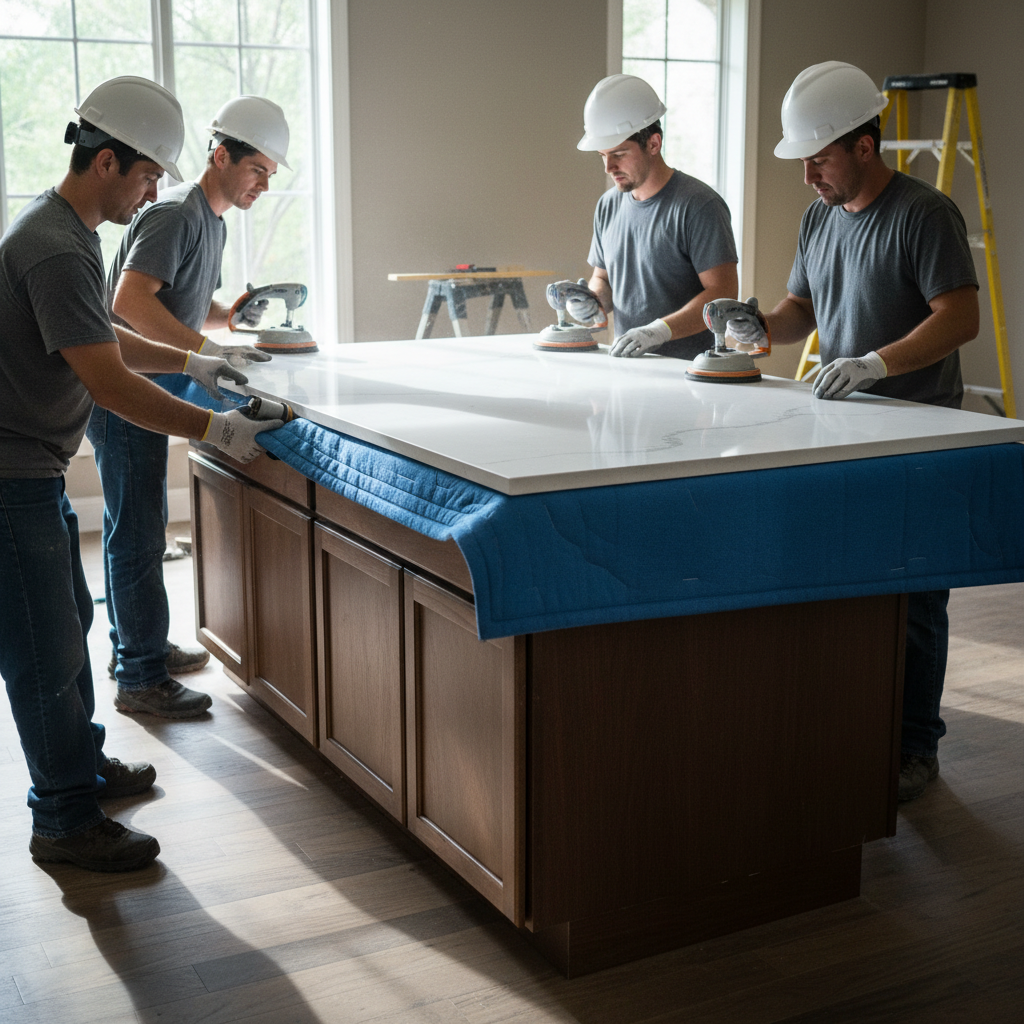
- Installation: Pro installers set, seam, and polish slabs; align to cabinetry within tight tolerances.
- Care kit + walkthrough: Cleaning guidance and maintenance tips at handover.
Why one vendor? Less friction. See our perspective on working with professional kitchen makers to keep timelines predictable and quality high.
Quality Controls that Protect Durability
- Cabinet leveling: Within ~1/8 in across long spans to prevent stress points.
- Corner radii: 1/8–1/4 in at inside corners to reduce crack initiation.
- Edge polishing: Consistent grits for smooth, chip-resistant finishes.
- Overhang support: Hidden brackets for 10–12 in seating overhangs.
- Adhesive selection: Color-matched seams with appropriate flexibility for micro-movement.
Local Tips
- Tip 1: When visiting our Brampton showroom at 11 Edvac Drive, bring cabinet doors and floor swatches—it speeds up quartz color matching.
- Tip 2: Winter installs are common in the GTA; allow extra entry protection and warm-up time so adhesives cure optimally.
- Tip 3: For condo projects, confirm elevator size and booking rules early; we coordinate slab logistics to fit your building’s requirements.
IMPORTANT: These tips reflect our day-to-day quartz projects across the GTA and help keep your installation smooth and on schedule.
FAQ: Quartz Countertop Durability and Care
Quartz is durable for busy kitchens: it’s non-porous, scratch resistant, and easy to clean. Avoid direct high heat and harsh abrasives, and use boards and trivets. With these habits, quartz countertops maintain their look and performance for many years.
- Do quartz countertops need sealing?
- No. Quartz is non-porous and doesn’t require sealing. Clean with mild soap and water; use pH‑neutral cleaners for tougher messes.
- How heat resistant are quartz countertops?
- They handle warm dishes but avoid placing hot pans directly on the surface. Use trivets to prevent thermal shock and protect the finish.
- Can quartz be used outdoors?
- Generally no. Many quartz pigments aren’t UV-stable in full sun. For exterior kitchens, choose materials designed for UV and weather.
- Will quartz scratch or chip?
- It resists everyday scratches well due to mineral hardness (Mohs ~7). Edges can chip under hard impact; eased edges and good habits reduce risk.
- How do you clean and disinfect quartz?
- Daily wipe-downs with soap and water work. For sticky residues, use a plastic scraper and a non-abrasive cleaner labeled safe for quartz.
Methodology: How We Evaluate Quartz Durability
We assess quartz via lab metrics (hardness, absorption, flexural strength), controlled fabrication standards, and field performance in GTA kitchens. We pair ASTM-style tests with our installation data to recommend finishes, edges, and supports that maximize long-term durability.
- Lab indicators: Quartz mineral hardness ~7 (Mohs); near-zero absorption typical of engineered surfaces; strong flexural strength across common spans.
- Fabrication standards: Level bases, inside-corner radii, correct edge polishing, and appropriate support hardware.
- Field data: Polished finishes and eased edges hold up best in multi-cook households and rental suites.
- Care variables: Trivets, cutting boards, and pH‑neutral cleaners preserve the look over years of daily use.
Looking beyond counters? Explore why a custom kitchen streamlines cooking, storage, and cleanup when planned as a complete system.
Conclusion
Quartz delivers a rare combo: non-porous stain resistance, scratch resilience, and low maintenance with designer looks. With smart edges, proper supports, and simple care, it keeps its showroom finish for years—an easy recommendation for GTA families who want style without extra upkeep.
Key Takeaways
- Non-porous quartz resists stains and doesn’t need sealing—ideal for daily cooking.
- Mohs ~7 hardness and smart edge profiles protect against scratches and chips.
- Plan seams, supports, and appliance clearances during design to extend lifespan.
- Polished finishes clean fastest; honed reads soft but may show oils.
- End-to-end delivery at 11 Edvac Drive aligns cabinets, counters, and backsplashes perfectly.
Ready to see quartz options in person? Book a design visit at our Brampton showroom. Our in-house team will model your kitchen in 2D/3D, recommend edges and supports, and coordinate quartz with factory-direct cabinetry—all in one consultation.
Related Posts
Why Choose Kitchen Renovation Company
Nowadays, Kitchen spaces are not only a place for cooking and serving food, but these areas act as a statement, as they speak a lot about a family, the philosophy and personality of individuals, and spaces. If you admire aesthetics and adorn the beauty of your home, you must pay attention to the interior design […]
How a Kitchen Renovation Contractor is Changing the Game
Lifestyle is all about bringing something coherent to the overall experience of living. The kitchen and closets stand as two of the most influential spaces in a home that add to the overall experience of living. A Kitchen Renovation Contractor in Whitby by the name of Altima Kitchen and Closets Inc. is changing the overall […]
How Media unit contractor in Whitby is Changing the Game
Lifestyle is all about bringing something coherent to the overall experience of living. The kitchen and closets stand as two of the most influential spaces in a home that add to the overall experience of living. A Media Unit Company in Whitby by the name of Altima Kitchen and Closets Inc. is changing the overall […]