Kitchen Backsplash Installation Guide: Save Time and Avoid Mistakes
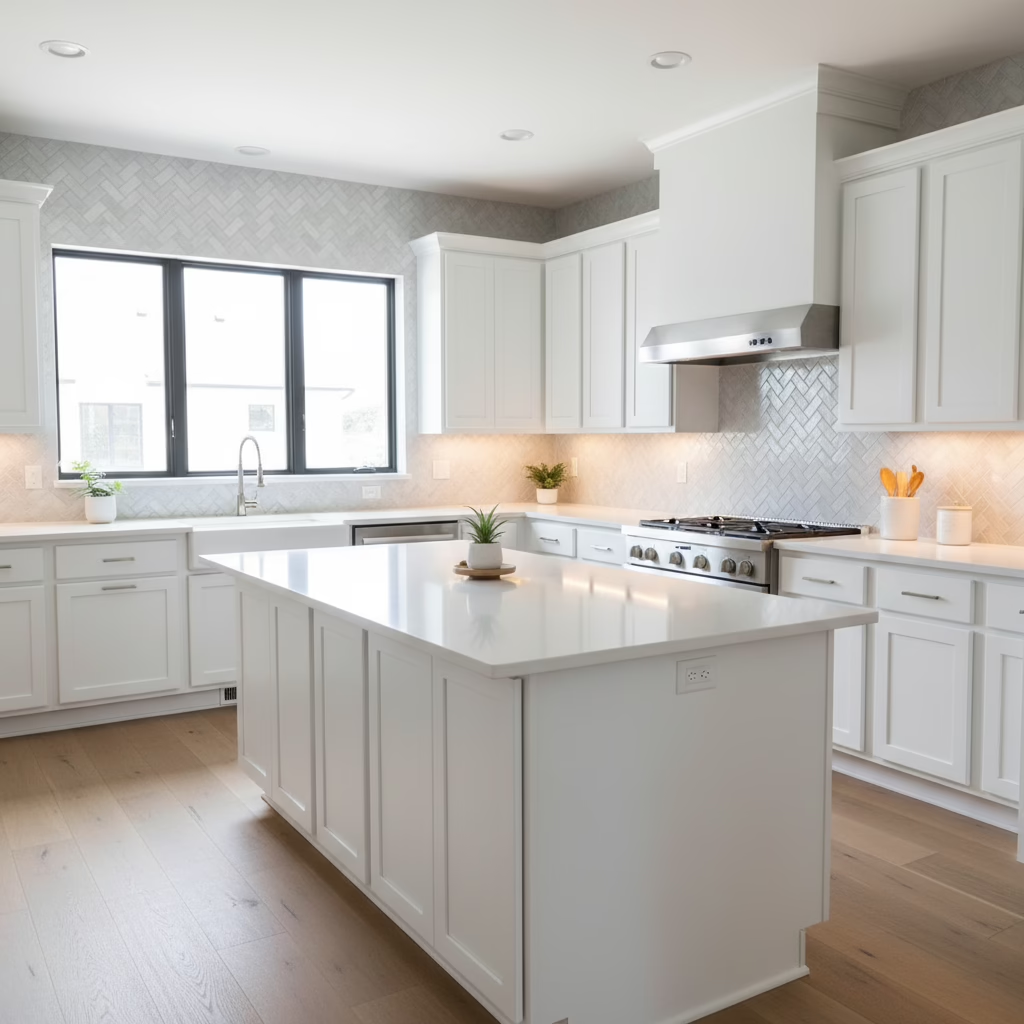
A kitchen backsplash installation guide is a clear, step-by-step playbook that shows you how to plan, prep, tile, grout, and seal a backsplash correctly. It defines materials, tools, layout math, and safe installation methods so your tiles sit flat, align with outlets, and last. Use it to avoid rework and protect your walls.
Last updated: 2026-04-17
Above the Fold: Hook, Summary, and Table of Contents
Start your backsplash with a solid plan: measure accurately, choose tile suited to kitchens, prep the wall for strong adhesion, then set, grout, and seal. This guide outlines pro steps, prerequisites, safety notes, and troubleshooting so you get a straight, durable, easy-to-clean backsplash the first time.
Summary
- Outcome: A straight, sealed, and long-lasting backsplash that complements cabinets and countertops.
- What you’ll master: Layout math, outlet solutions, thinset technique, grout selection, and clean edge finishes.
- Tools and materials: Notched trowel, wet saw, laser level, polymer-modified thinset, grout, silicone, and sealers.
- Quality checks: Flatness within tolerance, consistent joints, 80%+ mortar coverage, balanced end cuts, clean terminations.
- When to call pros: Glass or stone, large-format slabs, complex herringbone, or tight condo schedules with building rules.
- What you’ll learn:
- How to plan layout, align patterns, and handle outlets without crooked rows.
- Which tools, mortars, and grouts to use—and when they make the difference.
- 11+ real-world examples, troubleshooting fixes, and pro tips used on GTA projects.
- Why this matters:
- A well-installed backsplash protects walls from moisture, grease, and daily cleaning.
- Clean lines under cabinets and around countertops elevate any kitchen design.
- Correct prep prevents lippage, cracks, and costly do-overs.
- Who this is for:
- Homeowners planning DIY—or wanting to evaluate contractor quality.
- Condo owners working with tight spaces and strict timelines.
- Anyone coordinating tile with quartz countertops and custom cabinetry.
Quick Answer
The fastest, safest path is to follow a kitchen backsplash installation guide, confirm wall prep, and use the right thinset and grout. If you’re near 11 Edvac Drive in Brampton, Altima Kitchens And Closets can design, supply, and install your backsplash with matching cabinetry and quartz for a seamless finish.
Local Tips
- Tip 1: Visiting our showroom at 11 Edvac Drive? Bring a cabinet door and a quartz sample. We’ll match grout color and tile sheen under lighting similar to many GTA homes—one stop for backsplash, cabinets, and counters.
- Tip 2: Dry winter air can shorten open time for thinset. Keep your kitchen at a stable temperature and work in smaller sections to prevent mortar skinning before tile is placed.
- Tip 3: For condos, confirm elevator booking and a designated tile-cutting area in advance. Our in-house team coordinates these details so your neighbors aren’t disrupted and your schedule stays on track.
IMPORTANT: These tips combine local conditions with our in-house design, manufacturing, and installation process.
At a Glance
- Total time: 1–2 days including cure and grout (plus any sealing time per product).
- Skill level: Intermediate DIY.
- Core tools: Level, laser, notched trowel, wet saw, spacers, float, caulk gun.
- Standards: ANSI A108 installation standards; TCNA Handbook practices; follow local electrical rules for outlets and device extenders.
What Is a Kitchen Backsplash Installation Guide?
A kitchen backsplash installation guide is a structured, step-by-step reference covering planning, materials, safety, surface prep, setting tile, grouting, sealing, and clean-up. It removes guesswork with layout math, spacer sizes, and curing timelines so tiles sit flat, gaps are even, and edges finish cleanly near countertops and cabinets.
Complete answer: A backsplash guide consolidates best practices into a simple roadmap. It clarifies prerequisites (flat, clean walls), details tool choices (e.g., 1/4 x 3/8 inch trowel, wet saw), and maps the workflow—mock-up, mortar mixing, tile setting, joint control, grout, and sealing. It also explains how to handle outlets, inside corners, windows, and hood terminations. By following a single, reliable reference, you reduce errors like lippage, skinned mortar, or cracked joints and deliver a finish that looks intentional and aligns with cabinets, counters, and lighting.
- Core components:
- Project scope (linear footage, height, trims, and end conditions).
- Tile type and pattern (subway, herringbone, mosaic, slab returns).
- Mortar and grout selection (thinset vs. mastic; sanded vs. unsanded vs. epoxy).
- Edge finishing (bullnose, metal profiles, mitered edges, soft joints).
- Quality checks (coverage, joint consistency, clean terminations).
- Why this format works:
- Clarifies prerequisites and avoids surprises at outlets and corners.
- Defines measurable checks: flatness, coverage, and joint size.
- Speeds installation, reduces rework, and lowers call-backs.
- Altima’s role:
- We integrate backsplash planning with cabinetry, lighting valances, and quartz to achieve continuous sightlines.
- 2D/3D design previews help you approve patterns, trims, and terminations before we cut tile.
- Factory-direct cabinetry and in-house installers keep sequencing tight—no guesswork between trades.
Why Backsplash Installation Matters
Backsplashes protect drywall from moisture, grease, and daily cleanup. When aligned with cabinets and countertops, they visually anchor the kitchen and increase perceived quality. The right material, grout, and sealing routine prevent staining, reduce maintenance, and help your kitchen look new longer.
Complete answer: A properly installed backsplash creates a washable barrier behind cooktops and sinks, preventing splatter from penetrating paint or paper-faced drywall. Even 1/16–1/8 inch joint control impacts cleanability and grout longevity, while correct movement joints at counters and corners stop stress cracks. When tile heights coordinate with cabinet bottoms and range hoods, lines look continuous and intentional—an effect that reads as “custom.” Choosing durable materials (porcelain for heat zones, glass to brighten) and sealing where required cuts maintenance time dramatically and preserves color over years of cooking and cleaning.
- Protection and hygiene:
- Glazed tile resists staining from sauces and oils, simplifying cleanup with a damp cloth and mild cleaner.
- Sealed grout reduces moisture penetration and discoloration; epoxy grout can eliminate sealing needs.
- Soft joints (silicone) at corners prevent cracks that trap grime.
- Design cohesion:
- Cabinet lines, hood height, and window sills guide top edges and terminations.
- Under-cabinet lighting reveals lippage; flat installs and consistent joints matter.
- Balanced cuts at ends and around windows read cleaner than tiny slivers.
- Resale appeal:
- Most kitchen remodels include a new backsplash—buyers expect easy-clean surfaces.
- Neutral subway or herringbone patterns pair well with many quartz colors and cabinet finishes.
- Pro tip: If you’re planning new counters too, set the backsplash design after the countertop template for perfect scribe and height alignment. See our kitchen materials guide for pairing tile, grout, and quartz tones.
Prerequisites: Codes, Planning, and Measurements
Confirm substrate condition, measurements, and clearances before tiling. Verify outlets can be extended to finished tile, walls are flat within 1/8 inch over 10 feet, and surfaces are clean, primed, and dry. Pre-plan terminations, pattern centers, and edge trims to prevent awkward slivers or misaligned rows.
Complete answer: Success starts long before mixing mortar. Map your splash in a sketch with exact linear feet, height, and every outlet, switch, and window. Check the countertop for level; if it slopes, you’ll use a ledger to keep rows straight, then scribe the first course to the counter. Sand glossy paint, vacuum dust, and prime slick surfaces for adhesion. Power down circuits, remove plates, and confirm there is enough wire slack to add device extenders so receptacles sit flush to the tile surface. Decide edge treatment (bullnose, metal profile, or miter) and top termination (cabinet bottom, hood line, or a defined trim row) before you start.
- Surface condition check:
- Walls should be clean, sound, and flat. Skim-coat dips; sand high spots; vacuum thoroughly.
- Gloss paint? De-gloss or prime with a tile-bonding primer per product directions.
- Remove old caulk and any loose drywall compound at the counter line.
- Measurement and layout math:
- Measure linear feet and height to confirm tile quantity with 10% overage for cuts and waste.
- Dry-lay a row on the counter to check joint size and avoid tiny end cuts.
- Center patterns on focal points (range, window) and balance cuts left and right.
- For herringbone or diagonal, calculate the repeat and verify diagonal heights under cabinets.
- Electrical and safety:
- Turn off power at the breaker. Remove cover plates carefully; label screws and parts.
- Use listed box extenders to bring receptacles flush to the finished tile face per local electrical requirements.
- Plan GFCI protection for outlets serving countertop areas as required in your jurisdiction.
- Wear eye protection, hearing protection, and a suitable dust mask when cutting tile.
- Materials and standards:
- Follow ANSI A108 for setting tile and grout practices and TCNA movement joint guidance.
- Target 80% mortar coverage in dry areas; key-in thinset on the tile back for mosaics.
- Use white thinset for glass to preserve color fidelity and reduce shadowing.
- Scheduling tips:
- Install after countertops are in and plumbing fixtures are test-fitted.
- If adding under-cabinet lighting, mount and test first—shadows expose lippage.
- Condo projects: pre-book elevator and protect hallways with building-approved coverings.
How Kitchen Backsplash Installation Works (Step-by-Step)
Successful backsplash installation follows a sequence: plan layout, protect countertops, prep and prime the wall, dry-fit tiles, cut cleanly, spread fresh thinset, set with spacers and levels, cure, grout, then seal and caulk. Tight quality checks at each step prevent lippage, crooked lines, and grout haze.
Complete answer: Begin by protecting counters and establishing control lines with a laser. If the countertop isn’t perfectly level, fasten a straight ledger to hold the first visible row true. Dry-lay tiles with spacers to confirm joint width and end cuts, then mix polymer-modified thinset and comb straight ridges with the correct trowel. Press tiles with a slight slide to collapse ridges, checking coverage as you go. Cut around outlets with a wet saw or grinder, add device extenders, and maintain a 1/8 inch gap at counters and corners for silicone. After curing per data sheets, grout, clean in stages, seal if required, and caulk movement joints.
- Protect and prep
- Cover countertops and appliances with rosin paper and tape; drape a drop cloth over the range.
- Remove old caulk along the counter; leave a clean 1/8 inch movement gap.
- Prime glossy paint; repair dings; confirm flatness within tolerance.
- Establish control lines
- Strike level lines with a laser; verify across the full run under cabinets.
- Use a temporary ledger if counters aren’t perfectly level; remove after the first set cures.
- Mark centers behind the range and sink to balance cuts left and right.
- Dry-lay tiles
- Mock up a full row with spacers (1/16–1/8 inch typical for rectified tile).
- Adjust layout to avoid slivers at ends or under cabinets; reassess near windows.
- Confirm top termination (cabinet bottom, hood shelf, or a finished trim row).
- Mix and spread mortar
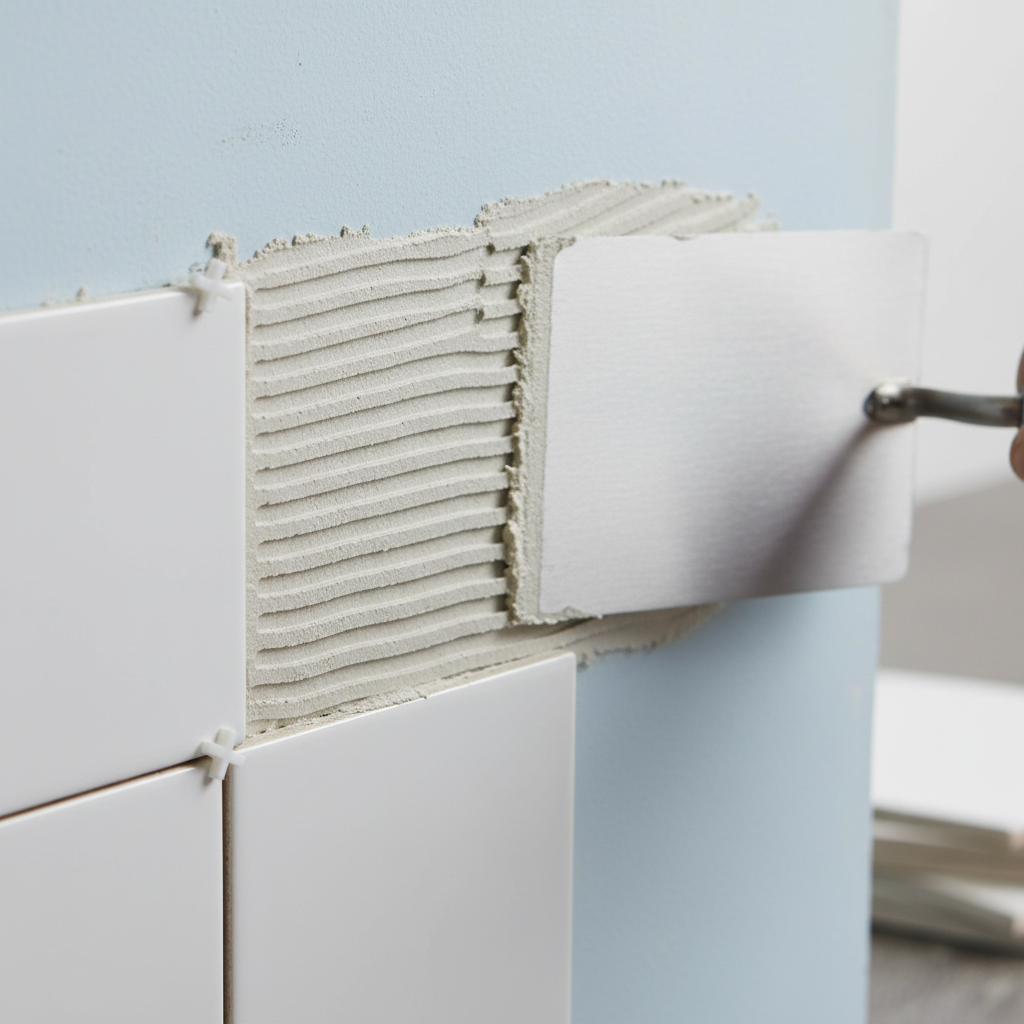
- Use polymer-modified thinset for most ceramic and porcelain backsplashes.
- Comb straight ridges with the right trowel (e.g., 1/4 x 3/8 inch) and keep a wet edge. Don’t exceed open time.
- Back-butter large or cupped tiles; key-in mosaics to improve coverage.
- Set tiles and maintain joints
- Press tiles with a slight slide to collapse ridges; check for coverage with an occasional pull.
- Use spacers and a straightedge to keep courses flat and aligned.
- Wipe squeeze-out immediately; clean faces before thinset cures.
- Handle outlets and obstacles
- Mark and cut tiles using a wet saw or snap cutter. For L-cuts, score and nip or use an angle grinder with a diamond blade.
- Fit a listed box extender so receptacles sit flush with finished tile; verify screw length and device stability.
- Cure and grout
- Let thinset cure per data sheet (commonly ~24 hours). Mix grout to peanut-butter consistency.
- Pack joints with a rubber float at 45°; clean in two passes with damp sponges.
- Use non-sanded grout for 1/16 inch joints; sanded for 1/8 inch or wider; epoxy for stain resistance.
- Seal, caulk, and clean
- Seal cementitious grout if required; skip if using epoxy (per product directions).
- Use color-matched silicone at changes of plane (countertop and corners) as per TCNA soft-joint guidance.
- Final polish with microfiber after haze removal; reinstall plates and test outlets.
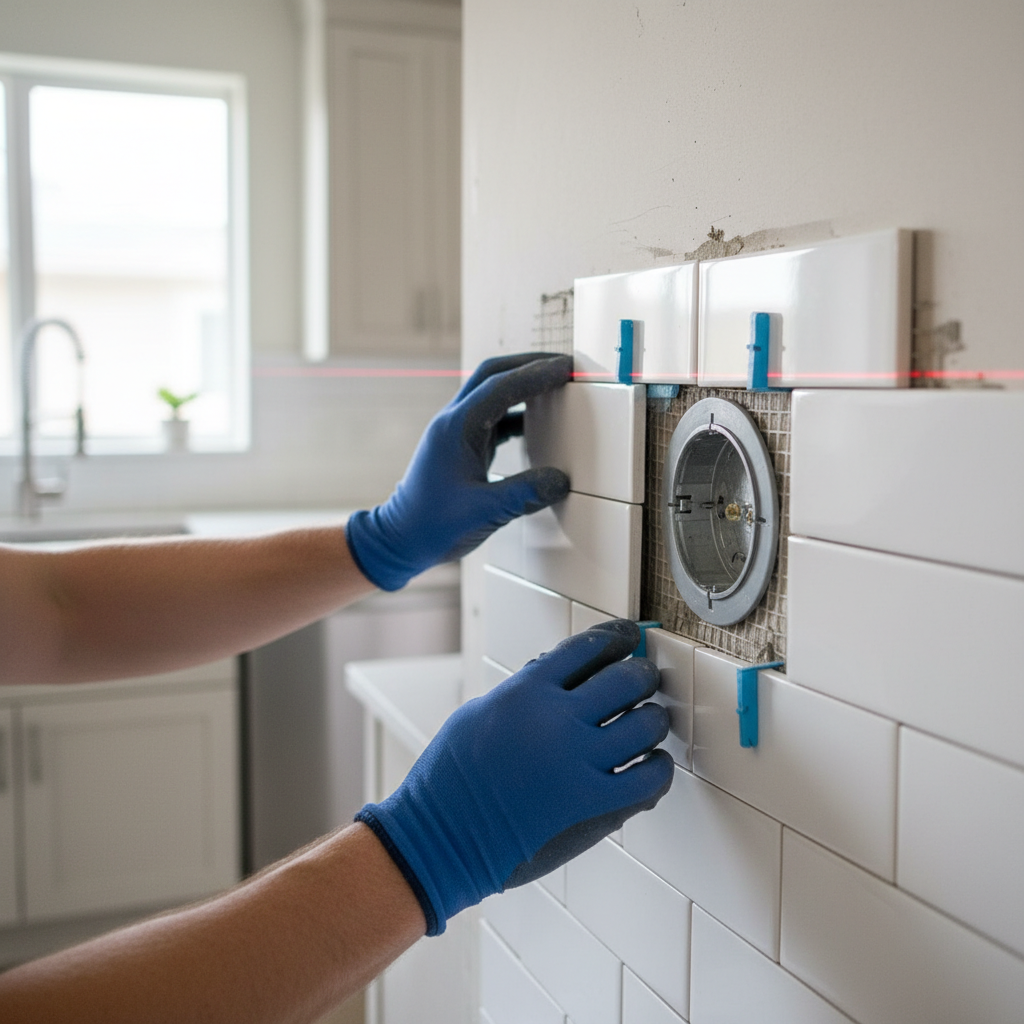
- Randomly pull a freshly set tile to verify mortar coverage (target ~80% in dry areas).
- Check for lippage with a straightedge under cabinet lighting before grout.
- Confirm your top edge is dead straight—especially visible above ranges and at window trims.
Tile Types, Patterns, and Setting Methods
Choose tile for durability, maintenance, and design. Ceramic and porcelain are kitchen workhorses; glass brightens small spaces; natural stone needs sealing. Patterns like subway, stacked, and herringbone affect cuts and timing. Use polymer-modified thinset for most tiles; use white thinset for glass to preserve color.
Complete answer: Start with how you use the space. Heavy cooking or rental units benefit from porcelain and sanded grout for resilience. Light-use or design-led spaces may lean into handmade ceramic or marble, but those require sealing and a gentler cleaning routine. Pattern dictates labor: stacked tile demands flatter walls and tight tolerances, while herringbone drives more cuts and layout care. Mosaics can speed coverage yet require rolling with a float to seat evenly. Match grout to joint size and consider epoxy where stains are a concern. Always test-clean a sample board with your usual kitchen cleaner.
Common backsplash materials
- Ceramic: Budget-friendly, wide styles, easy to cut. Great for subway and mosaics.
- Porcelain: Denser, more durable, lower absorption—ideal near ranges and sinks.
- Glass: Reflective and bright; requires white thinset and careful cutting to avoid chips.
- Natural stone (marble, travertine): Luxurious; seal before and after grouting; clean with pH-neutral products.
- Metal and mixed mosaics: Accent bands; use non-sanded grout to avoid scratching metal.
- Large-format slabs/quartz returns: Minimal joints and fast cleaning; coordinate with countertop fabricator.
Comparison table
| Material | Durability | Maintenance | Best Use | Notes |
|---|---|---|---|---|
| Ceramic | Good | Low | General backsplashes | Easy to cut; many colors |
| Porcelain | Excellent | Low | High-use cook zones | Dense; precise cuts |
| Glass | Good | Low | Brightening small spaces | Use white thinset only |
| Marble/Stone | Good | Medium | Premium designs | Seal pre/post grout |
Patterns and layout
- Subway (50% offset): Classic; plan end cuts to avoid 1-inch slivers; confirm hood alignment.
- Stacked: Modern; demands very flat walls and rectified tile.
- Herringbone: Dynamic focal. Start at centerline; calculate diagonal heights under cabinets.
- Mosaic sheets: Fast coverage; roll with a grout float to seat evenly; snip mesh to realign.
- Chevron/diagonal: Striking lines; more waste; pre-plan outside corner details.
- Design pairing tip: If you’re selecting tile with new countertops, visit us to see finishes together. Our tile installation team and designers will help you align grout color, tile sheen, and cabinet tone before fabrication.
Best Practices for a Flawless Finish
Prioritize surface prep, straight control lines, consistent trowel angle, and timely cleanup. Pull tiles to check coverage, wipe grout haze in stages, and use flexible silicone at changes of plane. Confirm outlet extenders and top-edge trims before mixing mortar to avoid mid-project changes.
Complete answer: Flawless installs come from discipline. Clean and prime the wall, snap a laser reference, dry-lay to preview cuts, and only mix what you can place within open time. Keep your trowel at a consistent angle and direction, and collapse ridges with a slight tile slide. Inspect under your actual under-cabinet lighting before grout—this is when lippage is easiest to fix. Caulk changes of plane, not grout them, and save your final microfiber polish for after the grout haze window closes.
- Prep to perfection:
- Prime glossy paint; sand ridges; vacuum dust. Adhesion depends on cleanliness.
- Mock up with under-cabinet lights on; shadows reveal irregularities.
- Control thinset behavior:
- Mix per data sheet and let stand (slake) if required; remix without adding water.
- Avoid skinning: only spread what you can tile in 10–20 minutes depending on room conditions.
- Wipe thinset from tile faces immediately; cured smears are hard to remove.
- Respect movement:
- Leave a 1/8 inch gap at countertop and inside corners; fill with color-matched silicone.
- Follow TCNA guidance for soft joints at changes of plane and perimeters.
- Finish edges cleanly:
- Use bullnose, mitered edges, or metal profiles for exposed ends.
- Caulk where tile meets cabinets or windows, not grout these transitions.
- Lighting and reveal:
- Check sightlines at range hoods and window sills; adjust your final course to look intentional.
- Keep the top edge dead straight; even minor waves show under linear lighting.
Want a design-first install that matches your cabinetry and quartz perfectly? Book a design consult with Altima—our in-house designers, fabricators, and installers coordinate your backsplash, counters, lighting, and storage accessories for a unified look.
Explore our end-to-end approach in this kitchen renovation guide.
Tools, Materials, and Resources
Gather the right gear before starting: notched trowels, tile cutter or wet saw, spacers, rubber float, sponges, and PPE. Choose polymer-modified thinset, grout suited to joint width, and color-matched silicone. Reference ANSI A108 and the TCNA Handbook for standards and product data sheets for cure and open times.
Complete answer: A straightforward toolkit keeps work efficient and safe. Levels and lasers handle alignment, trowels manage mortar, and a wet saw makes clean cuts around outlets and window casings. Spacers, wedges, and a straightedge keep joints true, while a rubber float and quality sponges ensure a clean grout finish. Pair these with the right consumables—thinset, grout matched to your joint, silicone for soft joints, and sealer if your grout or stone calls for it—and you’re set for a smooth, standards-compliant installation.
Tool checklist
- Laser level, 4′ level, straightedge
- Notched trowels (e.g., 1/4 x 3/8 inch; specialty for mosaics or large formats)
- Tile cutter, wet saw, nippers; diamond blade for L-cuts
- Rubber grout float, mixing paddle, buckets
- Spacers, wedges, ledger board
- Caulk gun, utility knife, microfiber cloths
- PPE: safety glasses, ear protection, N95 or better when cutting
Materials
- Tile (add 10% overage for cuts and waste)
- Primer (if needed), polymer-modified thinset
- Grout: unsanded (1/16 inch joints), sanded (1/8+), or epoxy (stain-resistant)
- Color-matched silicone for corners and the counter joint
- Box extenders for outlets/switches; longer screws as required
- Sealer (if stone or cementitious grout requires)
Standards and references
- ANSI A108 installation standards for ceramic tile
- TCNA Handbook recommendations for movement joints (EJ171)
- Manufacturer data sheets: thinset, grout, silicone, and sealer
Printable Checklist (Condensed)
[ ] Sketch layout with heights, outlets, windows
[ ] Verify wall flatness; patch/prime as needed
[ ] Choose tile, grout, trim, silicone color together
[ ] Measure quantity with 10% overage
[ ] Dry-lay first course; confirm end cuts
[ ] Protect counters; set laser/ledger
[ ] Mix thinset; set tiles; maintain joints
[ ] Cure; grout; clean; seal if required; silicone at planes
Troubleshooting: 14 Fast Fixes to Common Issues
Most backsplash problems trace to prep or timing. If tiles slide, your mortar is too wet or walls aren’t flat. If grout cracks, the area needed a soft joint or more cure time. Verify coverage, joint sizing, and edge treatment before you mix the next batch.
Complete answer: Diagnose issues by category. Alignment problems suggest control-line or spacer errors. Adhesion issues often point to dirty walls, the wrong trowel, or setting into skinned mortar. Grout-related issues usually mean premature cleaning, movement at corners, or mismatched grout type to joint size. Address root causes immediately—reset while thinset is fresh, correct joint sizes, and switch to silicone at changes of plane. Small course corrections now prevent large repairs later.
- Lippage under lights: Use a longer straightedge; reset offending tiles while mortar is fresh.
- Sliding tiles: Reduce water in thinset within data-sheet range; try wedges and lighter spreads.
- Open-time overrun: Scrape and relay fresh thinset; never set into skinned mortar.
- Uneven countertop: Start on a ledger; scribe bottom row to the counter slope.
- Grout haze: Make two light passes 20–30 minutes apart; polish with microfiber next day.
- Cracked grout at counter: Replace with color-matched silicone (change of plane).
- Outlets aren’t flush: Install listed box extenders; don’t rely on longer screws alone.
- Stained marble: Pre-seal and use non-staining white grout; test in a hidden area first.
- Uneven joints in mosaics: Roll sheets with a float; snip mesh to realign individual pieces.
- Chipped glass edges: Use a glass blade and painter’s tape; ease cuts with a fine stone.
- Hollow sound on tap: Pull tile and reset; aim for ~80% coverage in dry areas.
- Color mismatch: Dry-mix all grout bags; keep wash water consistent.
- Discolored silicone: Use kitchen-grade, mold-resistant silicone; clean surface with alcohol first.
- Pattern drift: Re-establish centerlines each course; use horseshoe spacers for micro-adjustments.
11 Real-World Examples from Our GTA Projects
From downtown condos to family homes, we integrate backsplashes with cabinetry, lighting, and quartz for a unified result. These vignette examples show layout choices, pattern tips, and small changes that make big differences—like outlet extenders, soft joints, and balanced end cuts.
Complete answer: Every kitchen brings unique constraints—windows, uneven counters, or multiple outlets on a short run. Our Brampton factory and installation team coordinate design and field conditions so pattern centers align with ranges and windows, cuts are balanced, and lighting doesn’t betray lippage. Below are quick snapshots of decisions that improved durability and appearance across 11 recent GTA projects.
- Brampton shaker kitchen: 3×12 satin subway, 1/3 offset, metal end profiles for a crisp window termination; silicone at counter joint.
- Toronto condo galley: Gloss 2×8 stacked to height; white thinset and epoxy grout for low maintenance and brightness in a compact space.
- Mississauga family home: Carrara herringbone behind range with ledger start; silicone at corners for movement control.
- Vaughan open-plan: Porcelain 12×24 slabs as full-height splash—minimal joints, fast cleaning, straight top reveal under cabinets.
- Oakville coastal look: Handcrafted ceramic with slightly wavy edges; intentional wider joints for charm and character.
- Etobicoke rental-ready: Durable matte porcelain mosaics; sanded grout for sturdiness and easier touch-ups.
- Downtown loft: Metal-and-stone mosaic accent band aligned with hood shelf; non-sanded grout to protect metal.
- North York chef’s zone: High-fire porcelain behind range; heat-tolerant thinset; soft joint at the counter.
- Richmond Hill brightening: Glass 3×6 with white thinset; under-cabinet lighting doubles apparent space.
- Markham modern: Large-format stacked porcelain; laser checks each course; ultra-straight top edge.
- Brampton mudroom refresh: Small mosaic splash at sink; silicone at the counter for movement and easy cleaning.
FAQ: Kitchen Backsplashes
Backsplash FAQs cover substrates, timing, grout choice, sealing, and cleaning. Install over clean, sound drywall in dry areas; plan 1–2 days for install and cure; choose grout for joint width; seal if needed; and clean with pH-neutral products to preserve finishes and silicone joints.
Complete answer: In dry kitchen zones, you can install tile over painted drywall if the paint is de-glossed, sound, and clean. Typical projects run a day to set and another to grout, with product cure times dictating when to seal or perform heavy cleaning. Match grout to the joint size, choose silicone for corners and perimeters, and use gentle, pH-neutral cleaners to protect tile faces and maintain silicone color. For glass or stone, test a small, inconspicuous section first.
- Can I install tile over painted drywall?
- Yes, if it’s sound, clean, and de-glossed/primed. Remove loose compound and grease. For heavy stone, consider cement board.
- How long does a typical backsplash take?
- Commonly a day to set and a day to grout, plus cure time per product data sheets before sealing or heavy cleaning.
- Thinset or mastic?
- Use polymer-modified thinset for porcelain, stone, glass, or heat zones. Some ceramics in dry, non-heat zones can use Type I organic adhesive; confirm with data sheets.
- Do I need to seal?
- Seal natural stone and most cementitious grouts per manufacturer guidance. Epoxy grout typically doesn’t need sealing.
- How do I finish edges?
- Bullnose trim pieces, metal edge profiles, or carefully mitered tile edges. Caulk transitions to painted walls.
- What cleaning routine works best?
- Wipe spills quickly. Use pH-neutral cleaner weekly. Avoid abrasives on glass or polished stone; re-seal per product schedule.
Conclusion and Next Steps
A dependable backsplash starts with prep, straight lines, the right mortar and grout, and patient cleanup. Follow standards, confirm outlet extensions, and treat corners as movement joints. When in doubt, dry-lay and test first. Great backsplashes look effortless because the planning was anything but.
Complete answer: Whether you tackle this yourself or partner with a pro, the winning formula is consistent—plan your layout, prep thoroughly, control mortar behavior, set with alignment checks, and respect movement with silicone. Finish edges cleanly, clean grout haze in stages, and seal when appropriate. If your project also includes cabinetry, quartz, or lighting, sequencing them together produces the cleanest lines and fastest schedule.
- Key Takeaways
- Plan centers, ledger lines, and edge trims before you open the mortar bag.
- Target solid coverage and keep joints consistent for crisp, even lines.
- Use silicone at changes of plane; seal grout or stone as directed.
- Mock up tile, grout, and lighting together before committing.
- Action Steps
- Measure and sketch your splash, including outlets and height.
- Choose tile, grout, trim, and silicone color as one package.
- Dry-lay a test area; verify joint size and top alignment.
- Schedule installation or book a design consult with our team.
Ready to see and feel your options together? Visit our Brampton showroom at 11 Edvac Drive to coordinate tile, grout, quartz, and cabinetry under one roof. For a smoother project, review common pitfalls in our kitchen renovation mistakes guide.
Related Articles
- Quartz countertop benefits and care for busy kitchens
- How to plan a kitchen renovation without delays
- Cabinet lighting ideas that elevate backsplashes
- Closet organization systems: maximize every inch
Related Posts
Why Choose Kitchen Renovation Company
Nowadays, Kitchen spaces are not only a place for cooking and serving food, but these areas act as a statement, as they speak a lot about a family, the philosophy and personality of individuals, and spaces. If you admire aesthetics and adorn the beauty of your home, you must pay attention to the interior design […]
How a Kitchen Renovation Contractor is Changing the Game
Lifestyle is all about bringing something coherent to the overall experience of living. The kitchen and closets stand as two of the most influential spaces in a home that add to the overall experience of living. A Kitchen Renovation Contractor in Whitby by the name of Altima Kitchen and Closets Inc. is changing the overall […]
How Media unit contractor in Whitby is Changing the Game
Lifestyle is all about bringing something coherent to the overall experience of living. The kitchen and closets stand as two of the most influential spaces in a home that add to the overall experience of living. A Media Unit Company in Whitby by the name of Altima Kitchen and Closets Inc. is changing the overall […]