Quartz vs Granite Countertops: Cost, Care, and Heat
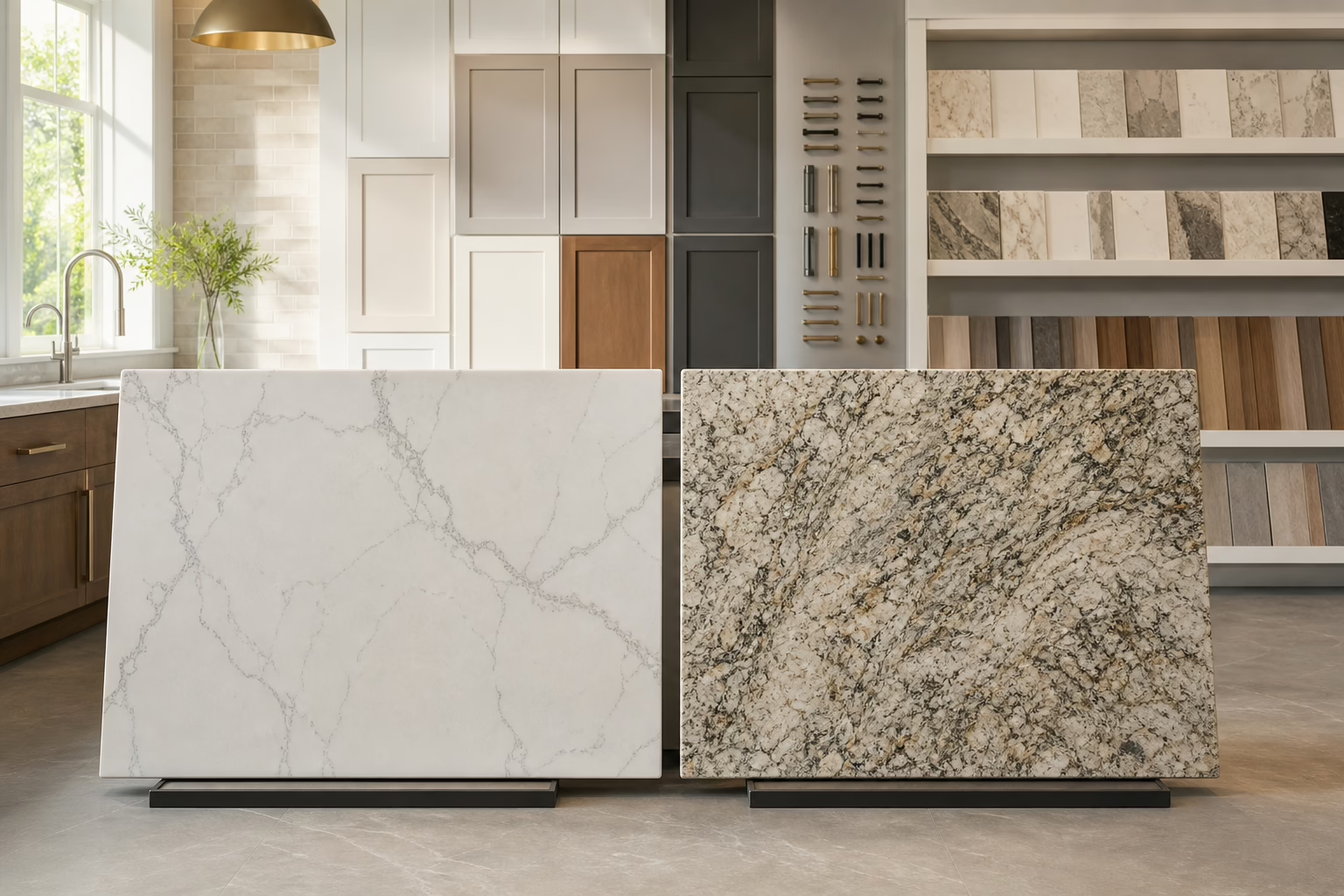
Quartz vs granite countertops come down to material, maintenance, heat tolerance, appearance, and budget. Quartz is engineered stone made from crushed quartz, resins, additives, and pigments, while granite is natural quarried stone. The better choice depends on your slab, layout, budget, and daily habits.
Quartz and Granite Are Different Materials
Quartz countertops are manufactured from crushed quartz, resins, additives, and pigments. This creates controlled colours and patterns, including designs inspired by marble. Engineered stone can contain 90% to 97% silica, according to the Canadian Centre for Occupational Health and Safety.
Granite is natural stone quarried and cut into slabs. Each slab has its own mineral pattern, colour variation, and movement, so viewing the actual slab matters.
Quartzite is a third material, not another name for quartz. It is natural stone formed from quartz-rich rock. If a selection is labelled “Taj Mahal,” ask whether it is Taj Mahal quartzite or manufactured quartz inspired by it. Composition, care, pattern variation, and price can differ.
Quartz vs Granite at a Glance

| Decision factor | Quartz | Granite |
|---|---|---|
| Material | Engineered stone made with crushed quartz, resins, additives, and pigments | Natural quarried stone |
| Appearance | Consistent colours and patterns | Natural variation and unique mineral movement |
| Routine care | Usually straightforward daily cleaning without routine sealing | Simple daily cleaning, with sealing based on porosity and product guidance |
| Stains | Generally resistant to ordinary kitchen staining, but spills should be wiped promptly | Resistance varies with the stone, finish, and sealing condition |
| Heat | Use a trivet because sudden or concentrated heat can damage the surface | More heat-tolerant, though trivets remain sensible |
| Scratches and impact | Durable for normal use, but not scratch-proof or impact-proof | Durable for normal use, though edges and weak points can chip |
| Slabs and seams | Consistent patterning can simplify planning, but slab dimensions still matter | Variation affects matching, while wider slabs may sometimes reduce seams |
| Best fit | Low-maintenance households wanting predictable design | Homeowners wanting natural character and heat tolerance |
How Each Surface Handles Daily Kitchen Use
Durability, scratches, and impacts
Both surfaces can perform well in a busy kitchen when properly fabricated, supported, and used as countertops rather than cutting boards. A heavy impact at an exposed corner or unsupported overhang can damage either material. Use a cutting board and avoid dragging heavy appliances across the surface.
Heat and hot cookware
Granite generally tolerates hot cookware better, but no countertop should be treated as indestructible. A very hot pan or baking dish can create thermal shock near a seam, cutout, edge, or damaged area.
Quartz contains resins, so direct heat presents a greater concern. Place hot pans on a trivet or heat-resistant pad instead of directly on quartz.
Stains and moisture
Quartz suits households that want a predictable cleaning routine. Its manufactured structure generally makes ordinary spills easier to manage, but oil, coffee, wine, food colouring, and dried residue should still be cleaned promptly.
Granite performance depends more on the stone and its surface treatment. Ask for the exact stone name and care instructions instead of assuming every granite behaves identically.
Appearance, Slabs, and Whether Granite Is Outdated
Granite is not automatically outdated in 2026. Its colour, movement, edge profile, backsplash, cabinet finish, and lighting determine whether the kitchen feels current. The dated effect usually comes from an uncoordinated combination of finishes, not simply from choosing natural stone.
Quartz offers more control over consistency. A controlled pattern can create a quiet background for painted cabinets or a continuous-looking island. Granite can make an island a natural focal point through its unique movement.
View the slab beside your cabinet door, flooring, backsplash, and hardware samples. Small samples can hide large-scale movement, so ask how the pattern will run across the island and where seams will fall. For a broader comparison of kitchen countertop material options, review the surface alongside cabinetry, layout, and the rest of the renovation scope.
Cleaning, Sealing, and Everyday Care
To clean quartz countertops, wipe spills with a soft cloth and mild soap or a suitable stone-surface cleaner, then remove residue with clean water. Soften dried food before lifting it with a non-abrasive tool approved for the surface. Avoid abrasive pads, harsh chemicals, and unsuitable cleaners. See this guide to quartz countertop care for a fuller routine.
Granite also benefits from prompt spill removal and a soft cloth. Use a natural-stone cleaner and avoid acidic or abrasive products. Sealing depends on porosity, finish, use, and the sealer, so there is no universal interval.
Cutting, drilling, grinding, sanding, and polishing engineered or natural stone can release silica dust. Ontario identifies these activities as potential workplace exposure points, so fabrication and installation require appropriate workplace controls. See Ontario’s silica exposure guidance and CCOHS information on engineered stone countertops.
Which Material Fits Your Household?
- Choose quartz if low routine maintenance, consistent colour, and predictable patterning matter most.
- Consider granite if you frequently cook with very hot cookware. Trivets remain sensible.
- Choose quartz if children or frequent entertaining mean regular spills and you prefer fewer maintenance decisions.
- Consider granite if you want a one-of-a-kind natural slab and accept variation.
- Choose either material for a statement island. Quartz can create a controlled waterfall look, while granite can provide natural drama.
- Choose based on the complete kitchen if budget is tight. Edge details, seams, and island complexity can affect the quote more than the material name alone.
What Quartz or Granite Really Costs to Install
Quartz is not always cheaper than granite, and granite is not always more expensive. Grade, slab availability, material quantity, fabrication, access, installation complexity, and surrounding renovation work determine the final price.
A comparable quote should separate material, templating, fabrication, delivery, installation, sink and cooktop cutouts, edge treatment, seams, backsplash work, demolition, disposal, plumbing coordination, and applicable charges. Comparing only a price per square foot can hide important differences.
A practical way to compare two quotes
Use a line-by-line worksheet before deciding. The following is a hypothetical comparison, not a market price or a quote. It shows why two countertops with the same footprint can have different totals.
| Cost item | Option A: quartz | Option B: granite |
|---|---|---|
| Countertop area | 60 sq. ft. at an illustrative $65 per sq. ft. = $3,900 | 60 sq. ft. at an illustrative $50 per sq. ft. = $3,000 |
| Sink and cooktop cutouts | List each cutout separately, with the same specifications used for comparison | |
| Edge treatment | Compare the actual edge profile and linear footage, not just the material name | |
| Seams and pattern placement | Confirm the number and location of seams, especially on an island | |
| Templating, delivery, installation, demolition, and disposal | Check whether each item is included, excluded, or priced as an allowance | |
In this example, the illustrative material difference is $900 before fabrication and installation are added. The lower material rate does not automatically produce the lower installed total if one option needs an extra slab, more complex pattern matching, additional edge work, or a different installation setup.
Cost factors that change the quote
- Square footage and slab count: A layout may require another slab if pieces cannot be nested efficiently.
- Island size and shape: Long, deep, curved, or waterfall islands may require more material and support.
- Pattern matching: Veined surfaces may require careful placement across seams.
- Edges: A standard eased edge and a detailed profile involve different fabrication work.
- Cutouts: Sink, cooktop, faucet, outlet, and soap-dispenser openings must match confirmed specifications.
- Backsplash: A short counter backsplash, full-height slab, or tile backsplash changes scope.
- Demolition and access: Removal, disposal, stairways, protection, and condo elevator coordination can affect labour.
For a kitchen renovation, compare the countertop material with the layout, cabinetry, and installation scope instead of choosing from a headline price alone.
Layout and Installation Details That Change the Decision
Coordinate countertop selection with cabinet measurements, appliance specifications, sink choice, backsplash planning, and the edge profile. A surface that looks ideal in a sample may create a seam, overhang, or cutout problem once the real layout is measured.
Slab width, island size, and seams
Many granite slabs are more than 70 inches wide, while quartz slabs are often about 56 to 65 inches wide. Exact dimensions vary by manufacturer, colour, and product line, so the slab plan must be checked against the finished cabinet layout.
A standard counter depth is about 25 to 26 inches including the countertop, while a kitchen island is commonly 36 to 48 inches deep before seating overhangs. A 36-inch-deep island can often be planned from one slab width, but a deeper island, a waterfall end, or a long island may require more than one piece or a seam.
For example, a 96-inch-long by 42-inch-deep island has 28 square feet of surface area before end panels and overhangs. The area alone does not determine slab use. The fabricator must also account for the slab width, cutout position, pattern direction, edge returns, and the need to avoid weak points around the sink or cooktop.
Place seams away from sink and cooktop cutouts where possible, and avoid placing them at narrow corners or unsupported transitions. On a veined quartz pattern or highly varied granite, seam visibility also depends on how the pieces are oriented and matched.
- Confirm the finished length, depth, and thickness of every counter run.
- Identify whether the island requires a seam.
- Ask how many slabs the layout uses and how much usable material remains after cutting.
- Mark the sink, faucet, cooktop, and other cutouts.
- Decide where seams will fall and whether patterns should align.
- Confirm overhang dimensions and support requirements.
- Review wall irregularities, appliance clearances, cabinet levels, and the supporting substrate.
- Coordinate thickness and edge details with the backsplash and adjacent surfaces.
Support should appear as its own quote item because the countertop relies on the base beneath it. Review this guide to countertop substrate selection for additional context.
Slab dimensions, layout geometry, pattern direction, and the cutting plan determine seam placement. Ask to see the proposed seam and cutout layout before production begins.
Questions to Bring to a Countertop Consultation
- What is the exact material name: engineered quartz, granite, or quartzite?
- Can I view the actual slab or a large sample?
- What thickness, finish, edge, and backsplash treatment are included?
- How many slabs are required, and where will seams be located?
- How will sink, cooktop, faucet, and other cutouts be measured and priced?
- Does the quote include templating, delivery, installation, demolition, disposal, and plumbing coordination?
- What support is required for the island and overhangs?
- What cleaning, heat, and sealing instructions apply?
- Who verifies appliance and sink specifications?
- What happens if measurements or selections change?
- Which warranty terms apply to material, fabrication, and installation?
For quartz, ask how the selected pattern will appear at seams and cutouts. For granite, ask how natural variation will be handled and what sealing guidance applies.
Frequently Asked Questions
Is quartz cheaper than granite?
Not consistently. Grade, slab availability, square footage, seams, edge work, cutouts, demolition, access, and installation can change the total more than the material category.
Is Taj Mahal quartz or quartzite?
Taj Mahal commonly refers to a quartzite natural-stone look, but supplier names vary. Ask whether the specific selection is quartzite or engineered quartz before comparing care and price.
Is granite outdated in 2026?
No. A well-matched granite slab can look current when its colour, movement, cabinets, backsplash, lighting, and edge profile work together.
Can you put hot pans on quartz or granite?
Use a trivet on both. Granite generally tolerates heat better, while quartz is more vulnerable to concentrated or sudden heat because it contains resins.
Does granite need to be sealed?
Some granite requires sealing or periodic renewal, but no single interval suits every slab. Porosity, finish, use, and sealer instructions determine the appropriate approach.
Is quartz suitable for an outdoor kitchen?
Not automatically. Prolonged sunlight, temperature changes, and product warranty limitations matter. Confirm outdoor suitability for the exact product. Granite is often considered outdoors, but its slab, finish, support, climate exposure, and installation still require review.
Choose the Surface With the Whole Kitchen in View
Choose quartz or granite after comparing the surface with your cabinets, backsplash, sink, lighting, island layout, care preferences, and complete written scope. The right countertop is the one whose tradeoffs fit your household and whose fabrication details are clear before approval.
Altima Kitchens And Closets offers kitchen renovations and quartz supply and installation for homeowners ready to move from material comparison to a defined project scope.
Related Posts
Why Choose Kitchen Renovation Company
Nowadays, Kitchen spaces are not only a place for cooking and serving food, but these areas act as a statement, as they speak a lot about a family, the philosophy and personality of individuals, and spaces. If you admire aesthetics and adorn the beauty of your home, you must pay attention to the interior design […]
How a Kitchen Renovation Contractor is Changing the Game
Lifestyle is all about bringing something coherent to the overall experience of living. The kitchen and closets stand as two of the most influential spaces in a home that add to the overall experience of living. A Kitchen Renovation Contractor in Whitby by the name of Altima Kitchen and Closets Inc. is changing the overall […]
How Media unit contractor in Whitby is Changing the Game
Lifestyle is all about bringing something coherent to the overall experience of living. The kitchen and closets stand as two of the most influential spaces in a home that add to the overall experience of living. A Media Unit Company in Whitby by the name of Altima Kitchen and Closets Inc. is changing the overall […]