
How to Compare Tile Flooring Installation Companies
Tile flooring installation companies do not all sell the same scope. One may focus on setting tile, another may coordinate a broader renovation, and a retailer may arrange installation through a separate provider.
These are delivery models, not claims about any specific company’s services. Altima’s current proposal must state whether it fits the project and what is included.

Compare three common installation models
| Company model | Often fits | Main trade-off | What to verify |
|---|---|---|---|
| Tile-focused specialist | Tile-only projects, complex patterns or scopes with defined surrounding work | Deep tile focus may require the owner or contractor to coordinate other trades | Substrate, layout, setting system, transitions and who handles adjacent work |
| Multi-trade renovation company | Projects where flooring interacts with cabinetry, trim, plumbing, demolition or room renovation | One coordination path can simplify handoffs, but technical tile responsibility must still be explicit | Who performs tile work, who supervises it and how technical decisions are documented |
| Retailer-arranged installation | Defined product selections and relatively standardized installation conditions | Product purchasing may be simple, but responsibility can be split among retailer, installer and manufacturer | Contracting party, site assessment, exclusions, claims path and product-versus-labour warranty |
No model is automatically superior. A tile specialist can be the right fit for a focused floor; a renovation company can be the right fit when multiple scopes meet; a retailer path can be convenient when responsibility is well documented.
Make every company respond to the same technical scope
Provide room dimensions, current flooring, known layers, visible damage, selected tile, pattern, occupancy conditions and transition points. Ask each candidate how it will assess the substrate and which conditions must be resolved before installation.
The Terrazzo, Tile & Marble Association of Canada publishes tile installation specifications and guides, and its installer standards material identifies substrate qualification, surface preparation, thin-set applications, installation methods and quality control as technical topics. The article does not prescribe a method; it gives owners questions to ask.
- What substrate is present, and how will its condition be assessed?
- Which preparation is included versus priced after exposure?
- What approved installation system matches the tile and location?
- How will layout, cuts, movement accommodation and transitions be planned?
- What site conditions must the owner maintain before and after work?
- Who documents concealed conditions and proposes changes?
Compare product responsibility and layout decisions
List who selects, purchases, receives, inspects, stores and protects the tile, setting materials, grout, sealant, profiles and transitions. If the owner supplies tile, clarify quantity, waste allowance, shade or lot considerations, delivery date and responsibility for damaged or short material.
Request a layout discussion before work begins. Starting point, focal lines, border cuts, doorway alignment, grout joint, pattern direction and transitions affect the visible result. A product image does not decide those details for the actual room.
Do not assume a company uses a specific material or offers a particular warranty. Ask for the proposed products, current technical documentation and written warranty terms for that project.
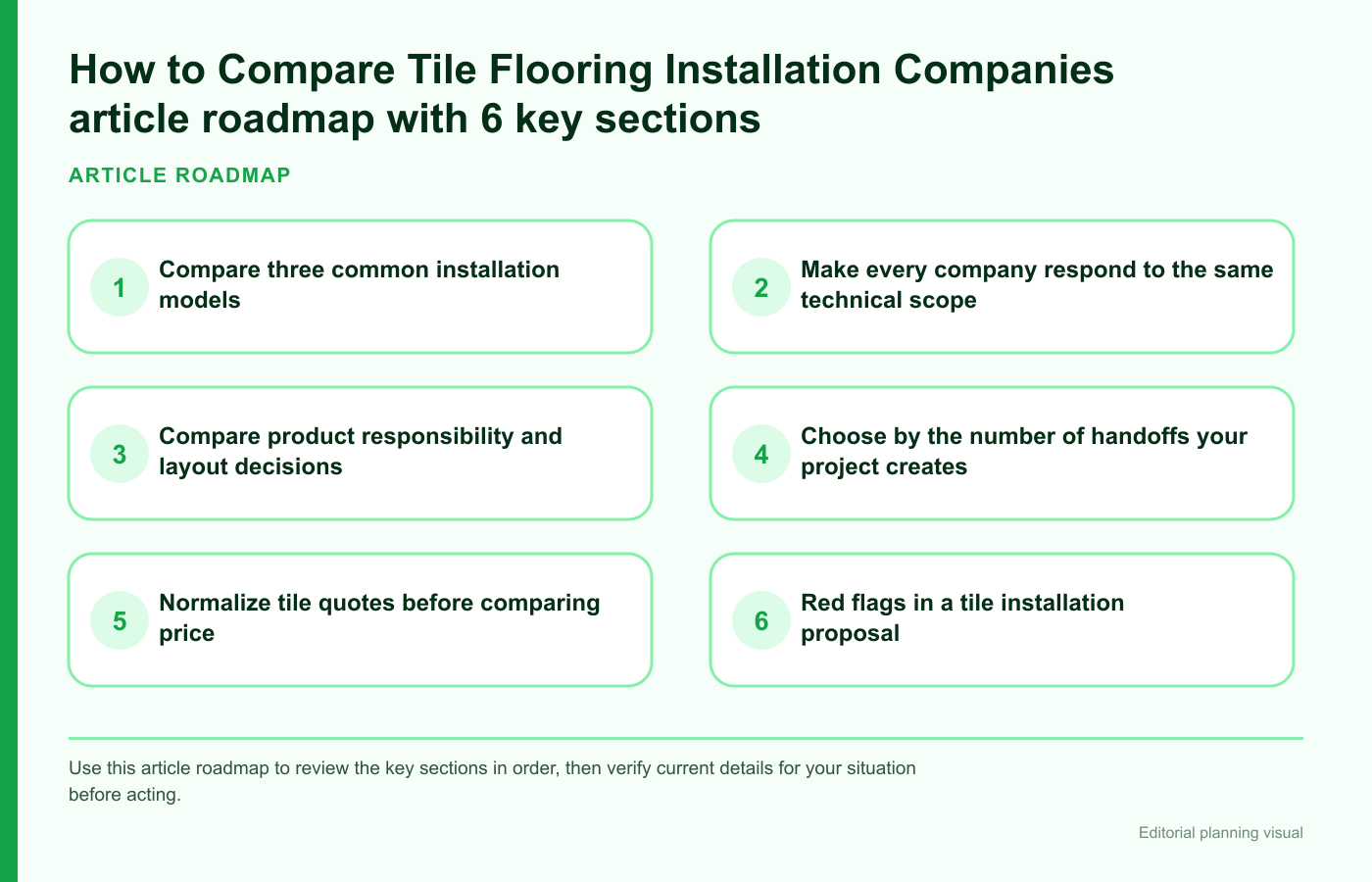
Choose by the number of handoffs your project creates
A tile-only floor may have clear boundaries. A renovation may require demolition, floor repair, plumbing fixture removal, cabinetry coordination, doors, trim, paint and cleanup. Map who owns each handoff and when the tile installer receives the site.
| Handoff | Question to resolve |
|---|---|
| Demolition to preparation | Who assesses the exposed substrate and authorizes corrective work? |
| Preparation to tile | Who accepts readiness and records the chosen system? |
| Tile to cabinetry or trim | Which elevations and clearances govern? |
| Tile to plumbing fixtures | Who removes, protects and reinstalls fixtures if applicable? |
| Installation to handover | Who documents care, deficiencies and warranty paths? |
Altima’s home renovation page presents flooring that includes tile and hardwood within a broader renovation category. This confirms only first-party positioning. It does not verify the proposed installer, method, products, service coverage, schedule or warranty for a particular project.
Normalize tile quotes before comparing price
Ask candidates to separate measurement, demolition, disposal, substrate preparation, tile, installation materials, labour, profiles, transitions, adjacent trades, site protection, cleanup, tax and allowances. A per-square-foot rate without inclusions cannot support a fair comparison.
Use one change-order process. The quote should explain what happens if demolition reveals additional layers, damage or an unsuitable base. Require written scope and price approval before added work proceeds.
Ontario’s consumer renovation guidance provides official contract and estimate context. Check the current provincial information and obtain legal advice for a specific agreement or dispute.
Red flags in a tile installation proposal
- No substrate discussion: the quote assumes the most important hidden condition away.
- One price with no materials list: product responsibility is unclear.
- No layout review: visible decisions may be made after installation starts.
- Undefined adjacent work: fixture, trim and doorway gaps can appear.
- Credential or certification claims without verification: confirm them with the issuer.
- Warranty language without scope: identify labour, product, exclusions and claim path.
- Pressure to buy before site assessment: the proposed method may not match actual conditions.
- No written change process: concealed conditions can turn into disputes.
Use this decision scorecard
| Criterion | Evidence |
|---|---|
| Technical fit | Written substrate, method and quality-control response |
| Scope completeness | Demolition, preparation, installation and handoffs assigned |
| Product clarity | Named materials, supplier responsibility and substitution process |
| Quote transparency | Fixed work, allowances, options and exclusions separated |
| Change control | Concealed-condition and written approval process |
| Verification | Current insurance, references and applicable claims checked |
| Handover | Care, deficiency and documented warranty path |
Weight technical fit and scope completeness more heavily than sales presentation. The decision should answer why that company model fits the work.
Common tile company comparison mistakes
- Choosing by tile price while ignoring floor preparation
- Comparing tile-only labour with a multi-trade quote
- Assuming retailer, installer and manufacturer share one warranty
- Buying material before verifying quantity and installation compatibility
- Leaving door, trim, cabinetry and fixture responsibilities unresolved
- Using photos as proof without confirming the company’s role
Frequently asked questions
Is a tile specialist always the best choice?
No. A specialist may fit demanding tile work, while a multi-trade company may fit a renovation with many handoffs. Compare verified scope and responsibility.
Should every tile company include floor preparation?
Do not assume it. Ask what assessment and preparation are included, what remains an allowance and how changes are approved.
Can I compare companies by a per-square-foot rate?
Only after normalizing removal, substrate, materials, patterns, transitions, adjacent work and tax. Otherwise the rates describe different scopes.
What should be written before work starts?
Record the room, tile, layout, preparation assumptions, materials, trade boundaries, price structure, payment, changes, cleanup and warranty if offered.
Choose the company that makes responsibility visible
A good tile company comparison explains who owns every decision from substrate assessment to handover.
Sources reviewed
- Altima Kitchens And Closets and home renovation page — first-party service-category context only.
- TTMAC specifications and guides and installer standards course outline — Canadian technical-topic context, not proof of any company’s certification.
- Government of Ontario renovation consumer guidance — official contract and estimate context.